Fact sheet
- Name — Iqamah
- What it is — a native macOS menu bar app for Islamic prayer times, the Quran, the Hijri calendar, and worship records: prayers, dhikr, fasting, and listening
- Current version — 2.10: the Today page names the five times prayer is not offered and lays out the twelve rak‘ah of the confirmed sunnah at the times they belong to, both drawn from the same prayer times as the rest of the screen; the Ramadan countdown reaches the menu bar panel; and an excused day can be undone from any square on it. 2.9 made the word being recited the word you are looking at — word-by-word highlighting that follows either voice, and goes back when the reciter repeats a phrase. 2.8 made an excusal about a prayer rather than a day (a single prayer, or a range from Fajr one day to Dhuhr another) and put a transliteration line under the Arabic. 2.7 grew the Quran — a second reciter, Sheikh Ali Al-Hudhaify, beside Maher Al-Muaiqly; juz markers with a khatmah record in Habits; a written note on any ayah; and recitation that plays until you stop it. 2.6 put the Quran in the app, free — all 114 surahs in the mushaf’s Uthmani script, ayah-by-ayah recitation that follows the text, translations with the translators’ footnotes, search, favourites, and offline downloads. Atop 2.0’s redesign: the panel with its living sky, one window, excused days, and a fasting record with a Ramadan ledger
- Developer — StacknScope Inc., Ontario, Canada
- Platform — macOS 14 or later, Apple Silicon; Liquid Glass on macOS 26 Tahoe
- Price — free. Iqamah Pro is a one-time $4.99 covering three Macs, with no subscription
- Languages — 18, including Arabic, Urdu, Farsi, Bengali, Hausa, Indonesian, Malay, Turkish and Bosnian, with full right-to-left support
- Website — iqamahapp.com
- Contact — support@stacknscope.com
Descriptions
Use whichever length fits. No need to credit or ask.
One line
Prayer times in your Mac’s menu bar, under a sky drawn from your own day — and now the Quran, free. Native, quiet, private.
Short
Iqamah is a native macOS menu bar app for Islamic prayer times. One click opens the panel: the sky as it is right now over your city, drawn from your own prayer times, with the next prayer marked in gold and a Mark prayed button a keystroke away. The Quran is in the app and free — the mushaf’s Uthmani text, recitation that follows the text ayah by ayah, and word by word, in two voices, Sheikh Maher Al-Muaiqly and Sheikh Ali Al-Hudhaify, the thirty juz marked with a khatmah record to match, a written note on any ayah, translations with the translators’ notes, search that forgives spelling, and offline downloads for a surah or the whole Quran. The Hijri calendar, prayer and fasting records with excused days, a tasbeeh counter with routines, widgets, and a day planner around your salah complete it. Prayer times, the adhan, the habit tracker and the Quran are free; a one-time $4.99 unlocks the rest on up to three Macs.
Longer
Iqamah keeps the next prayer and a live countdown in the macOS menu bar, sounds the adhan when it arrives, and stays out of the way the rest of the time. A left click opens a panel rather than a menu: the sky over your city, keyframed on your own prayer times — first light at Fajr, gold at sunrise, orange at Maghrib, navy after Isha — with the sun on its arc, every prayer of the day and its state, and a Mark prayed button on the one whose time it is. The panel takes the keyboard without stealing focus, the way Spotlight does, and on macOS Tahoe it sits on Liquid Glass. After Isha it wears the Lantern: navy under a gold lattice, with a ring that fills as the night runs toward Fajr.
Version 2.6 put the Quran in the app, free — because a customer asked why she had to leave for YouTube to hear a surah. All 114 surahs in the mushaf’s own Uthmani script, drawn in a typeface made for it; recitation by Sheikh Maher Al-Muaiqly that lights the ayah being recited and keeps it in view, continuing surah to surah in the order of the mushaf; Saheeh International and Al-Hilali & Khan translations with the translators’ own footnotes; search by number, name, meaning or the way a word sounds; favourites, a bookmark, and a separate continue-listening position. One button downloads the surah being read; Settings downloads the whole Quran (about a gigabyte — the app names the exact figure first) and removes it again on request. While a recitation plays, the panel shows a Now Playing card; the adhan pauses the recitation and hands it back afterwards; on Fridays the reminder and the panel’s card open Surat al-Kahf. Listening joined the Habits window as a third mode: an ayah that plays to its end is counted for the day, and nothing is marked by hand. Version 2.7 answered her follow-up: a second voice, Sheikh Ali Al-Hudhaify, switchable mid-recitation; the thirty juz marked through the reader with a khatmah record in Habits; a written note on any ayah, gathered under My Notes; and a recitation that keeps playing wherever in the app you go. Version 2.8 added a transliteration line under the Arabic, off until asked for, with search that reads it. Version 2.9 answered the fourth thing she asked for: the word being recited stays at full strength while the rest of the ayah steps back, moving as the reciting moves and going back when the reciter repeats a phrase. Sheikh Maher Al-Muaiqly’s timings were published for his recording and checked word by word; none existed for Sheikh Ali Al-Hudhaify, so they were measured from his recording, every word of every ayah.
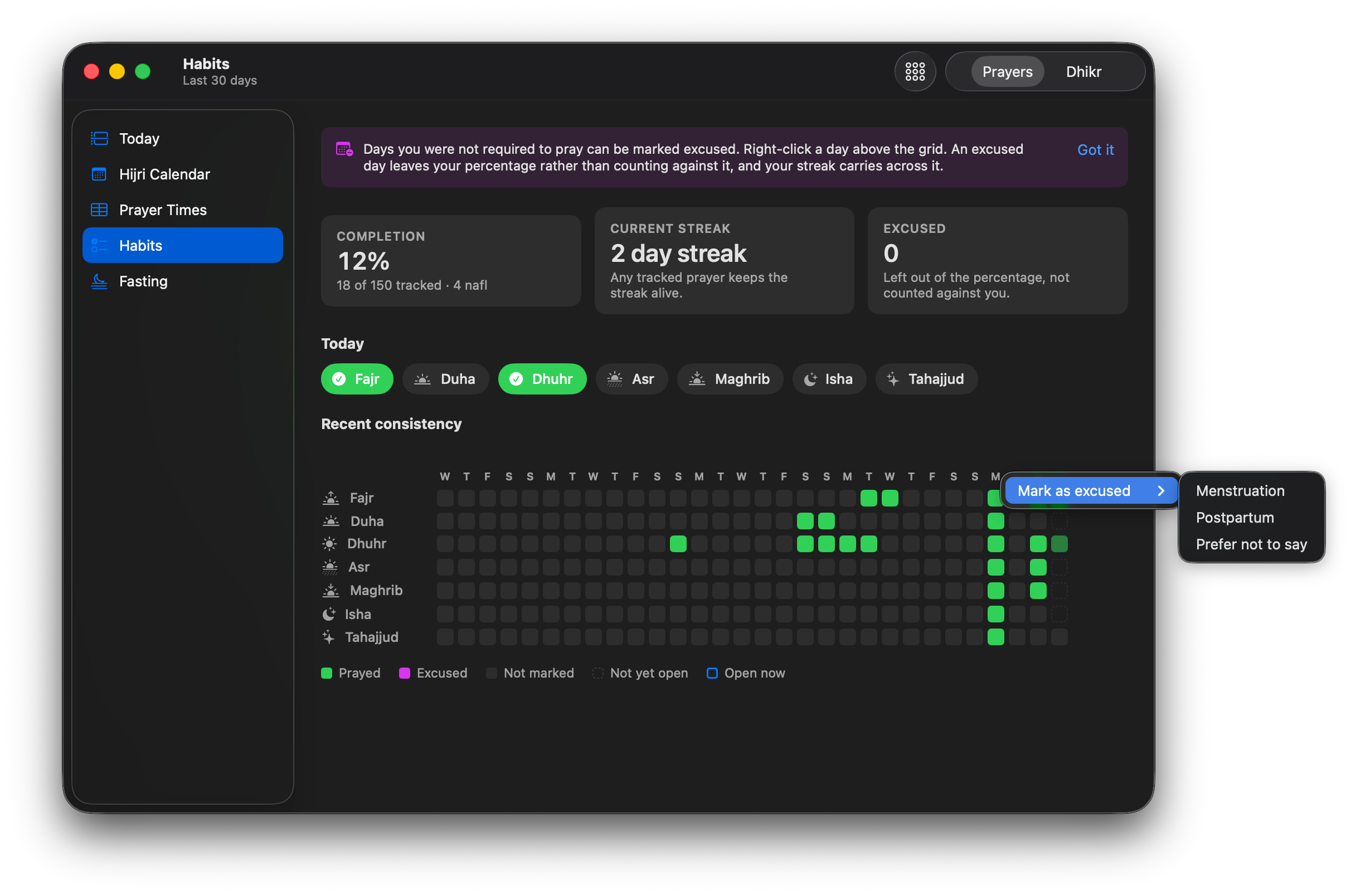
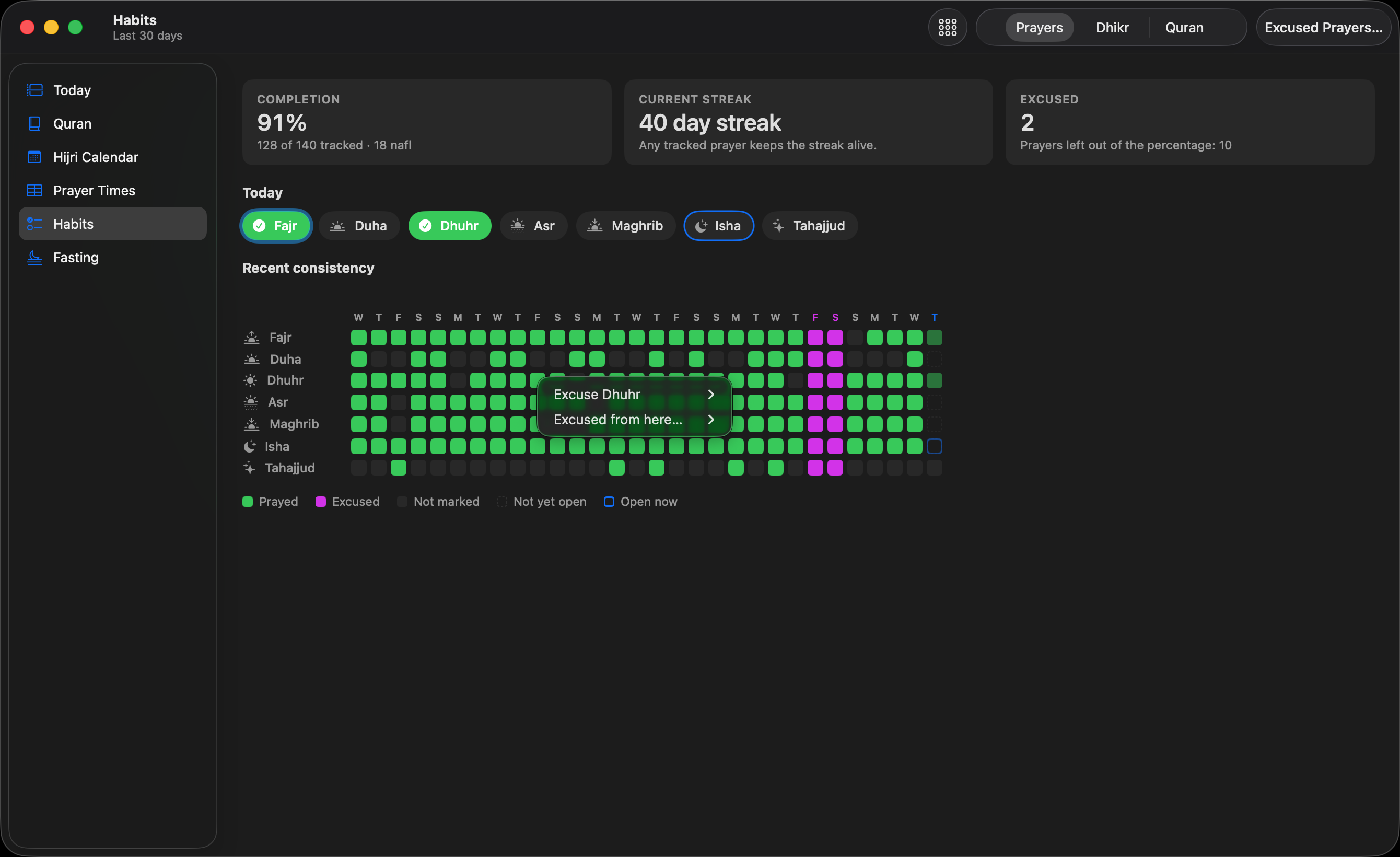
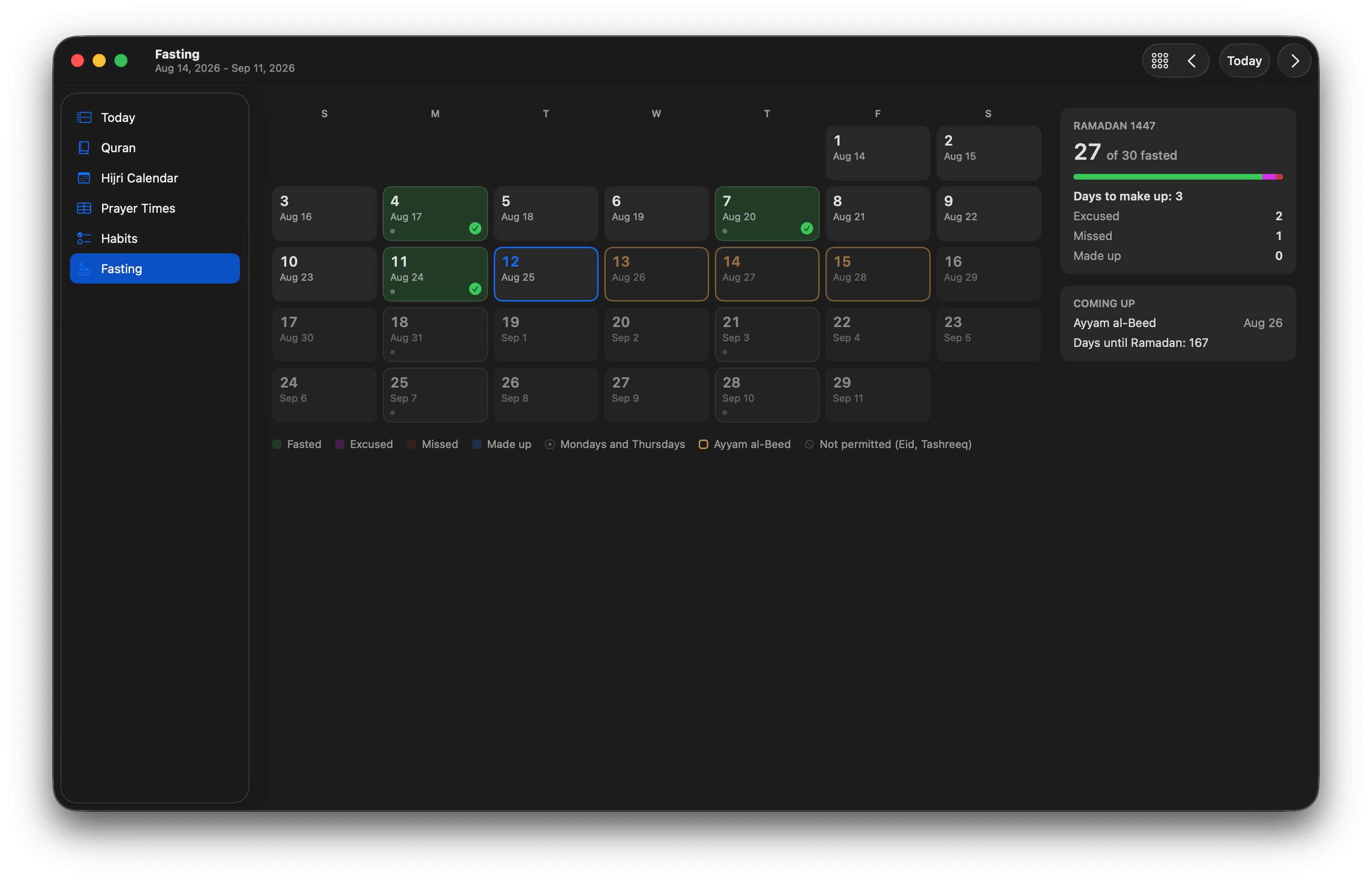
It is written in Swift as a real menu bar app rather than a website in a wrapper, with WidgetKit widgets, 18 languages including full right-to-left support, and no account, no tracking and no analytics of any kind inside the app. Today, the Hijri calendar, the prayer tables, Habits and Fasting are sections of one window with a sidebar; since 2.10 Today also names the five times prayer is not offered and the twelve rak‘ah of the confirmed sunnah, each at the time it belongs to, both drawn from the same prayer times as everything else on the screen. The habit tracker — free for everyone in 2.0 — records the five daily prayers, Duha and Tahajjud, and understands the days that do not fit a streak: a day you were not required to pray can be marked excused, leaves your percentage entirely, and your streak carries straight across it. Since 2.8 an excusal can be a single prayer, or a range from Fajr one day to Dhuhr another, and the percentage counts only the prayers that were actually due. The reason you record never leaves your Mac, and since 2.10 an excused day can be undone from any square on it, the Duha and Tahajjud squares included. A fasting record covers the whole year — Mondays and Thursdays, the white days, Ramadan — refuses the mark on Eid and Tashreeq, and keeps a ledger of Ramadan days to make up, with a countdown to the next Ramadan in the menu bar panel as well as the Fasting tab.
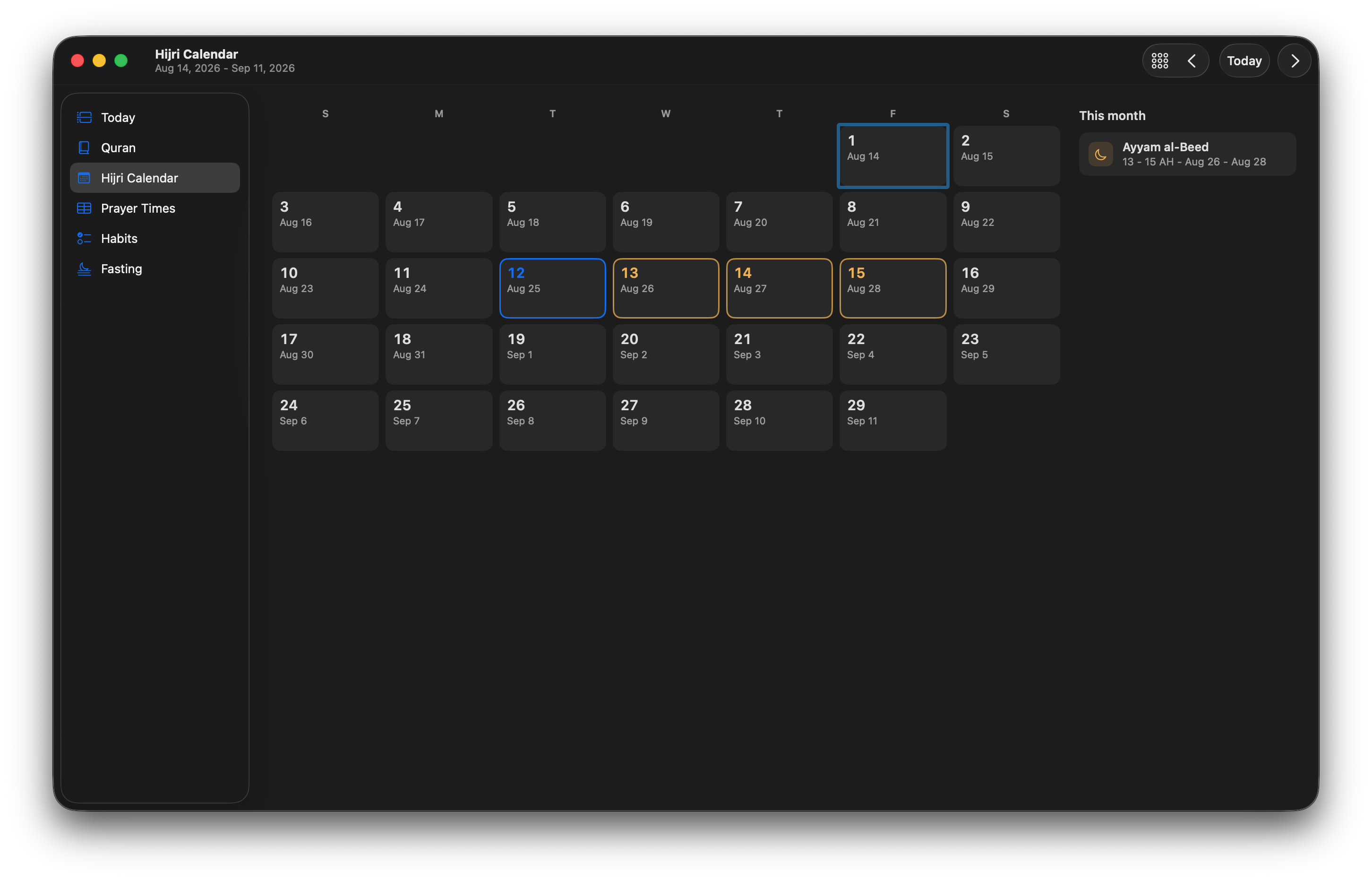
Prayer times are calculated from the standard astronomical methods, with the calculation method, madhab and per-prayer adjustments all configurable, because no single set of numbers is correct for every community. The panel names the method and school it used, and a Diagnostics page under Help says what Iqamah believes — location, permissions, the next alert — with a button beside anything that needs fixing. Iqamah Pro, a one-time $4.99 covering three Macs, adds the Day Planner (each prayer window against what is already booked, with a suggested time inside it), the Hijri calendar with Islamic events and their evidence, monthly and yearly prayer tables, a tasbeeh counter, the widgets, calendar-aware planning that reads only when events start and end — never titles — and settings sync through a visible file in a folder you choose in iCloud Drive. There is no subscription.
Screenshots
Right-click to save. Captured on macOS 26 with the location set to Makkah. PNG with window transparency except where noted.
The Quran
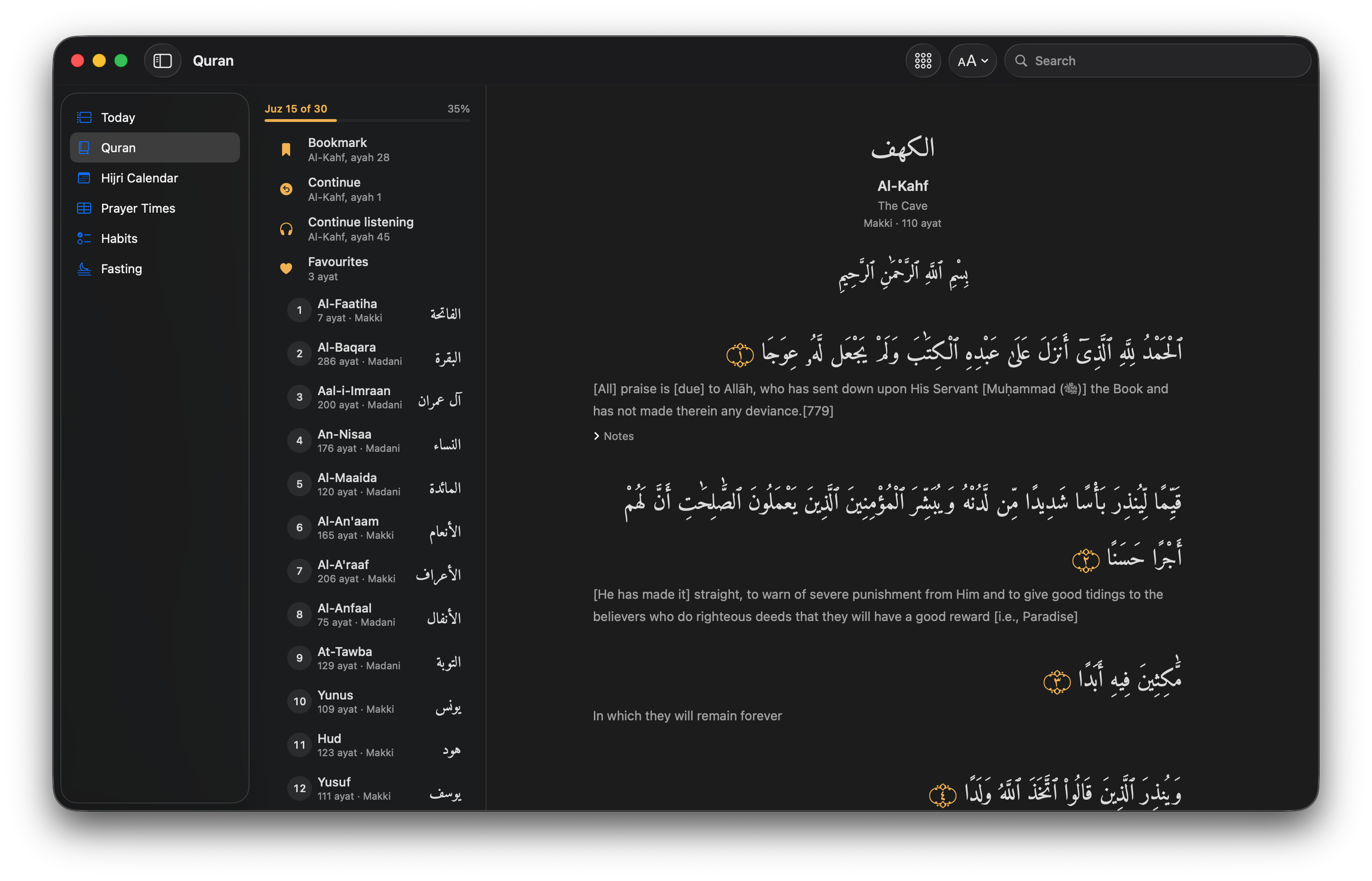
- The Quran reader — Surat Al-Kahf with the Saheeh International translation and its footnotes, the juz bar above the surah list (2.9)
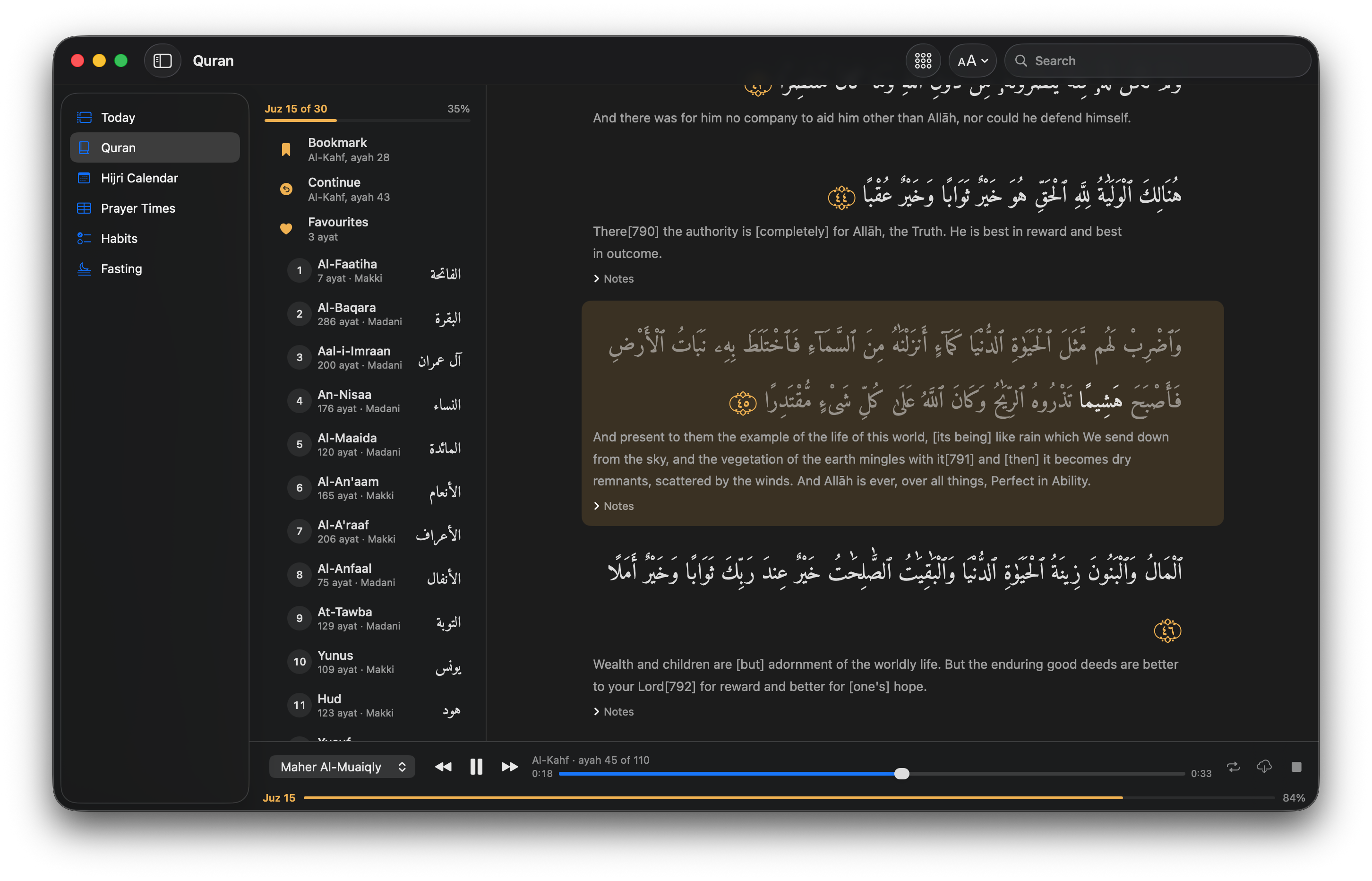
- The reader mid-recitation — the current ayah highlighted, the word being recited at full strength, the player bar naming the juz (2.9)
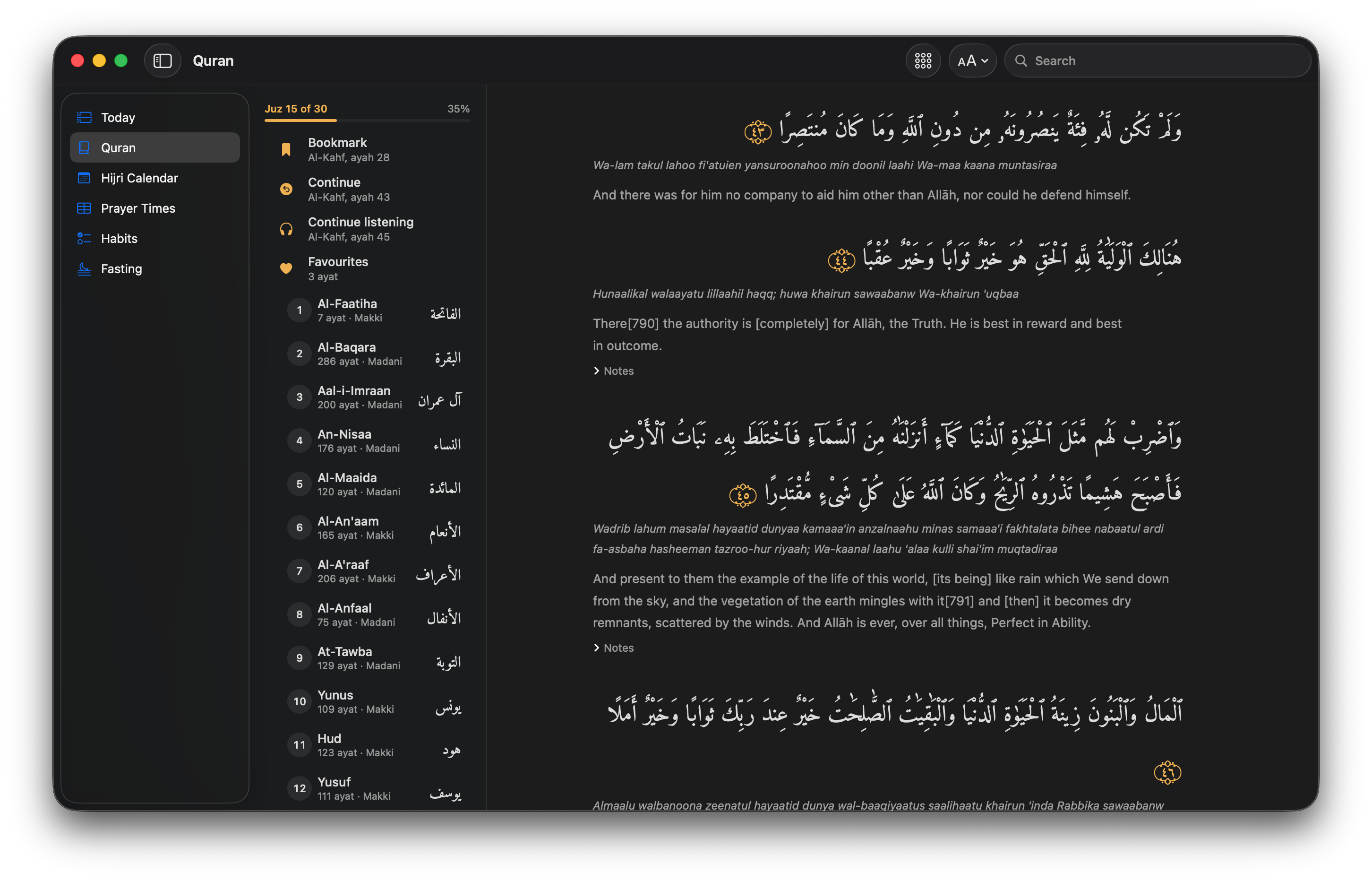
- Transliteration on — the romanised line between the Arabic and the translation (2.8)
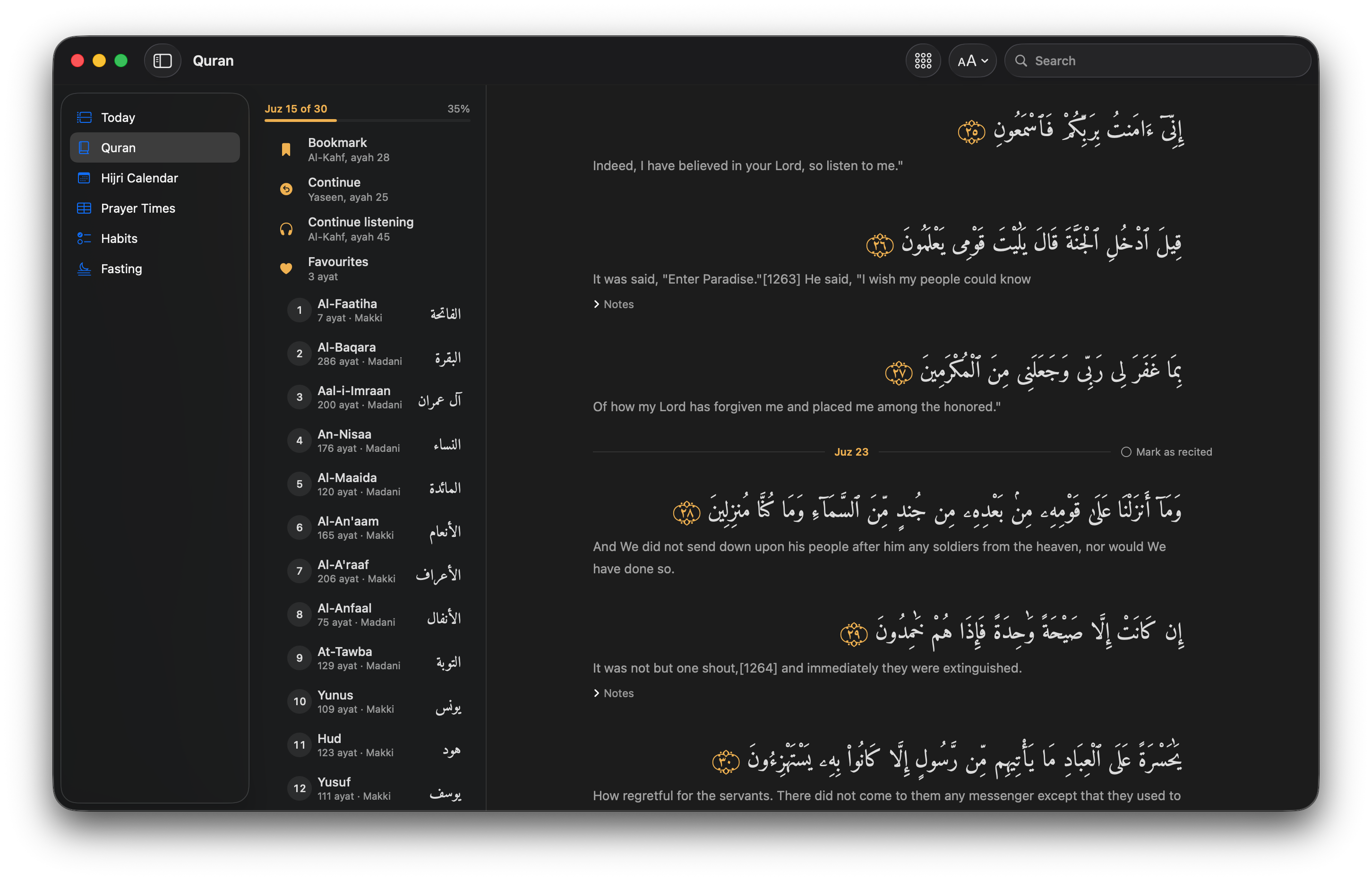
- Where juz 23 begins — the gold rule at Ya-Sin 28 with Mark as recited (2.7)
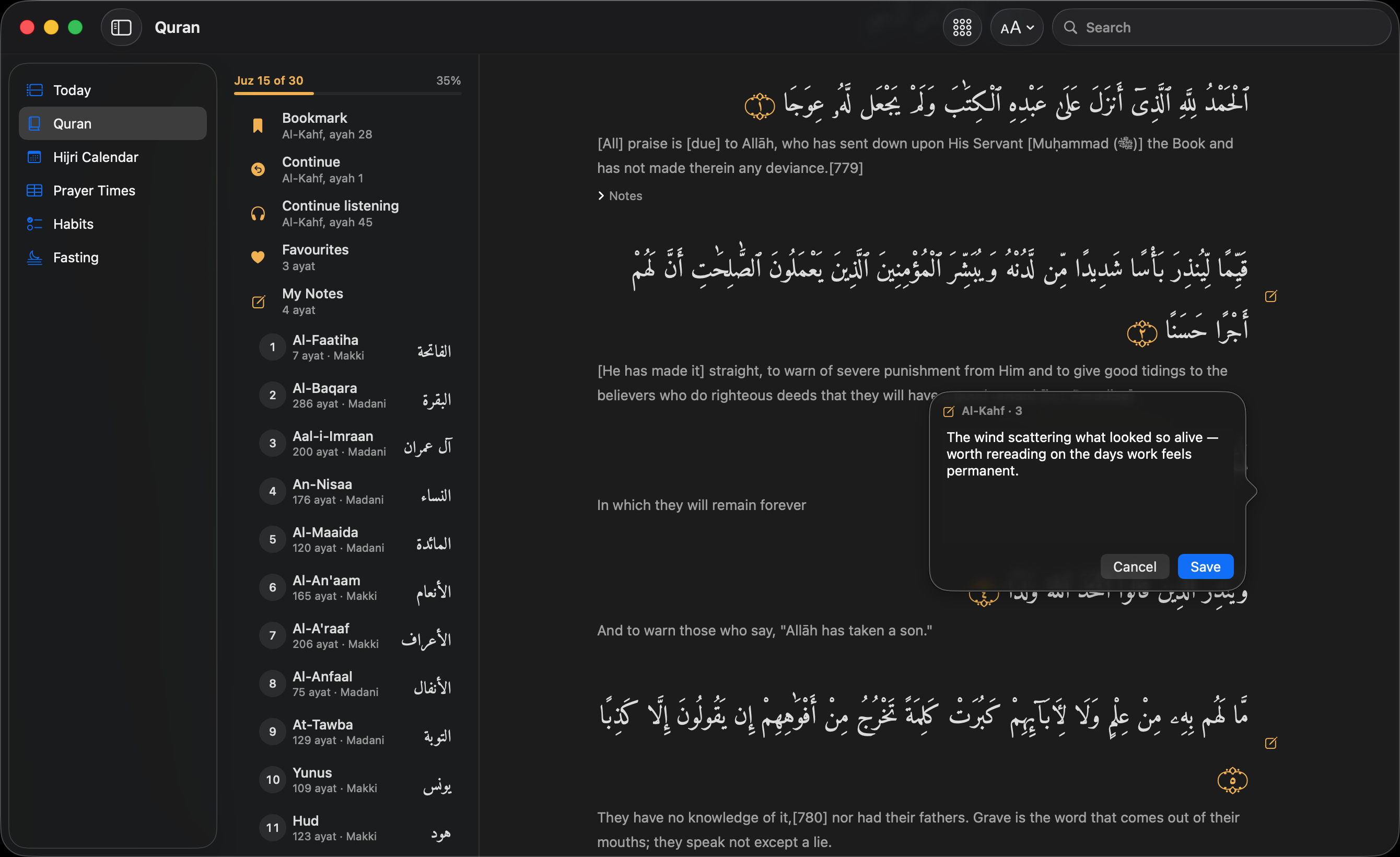
- The note editor open on an ayah, gold pencils on noted ayat nearby (2.7; flat capture, no transparency)
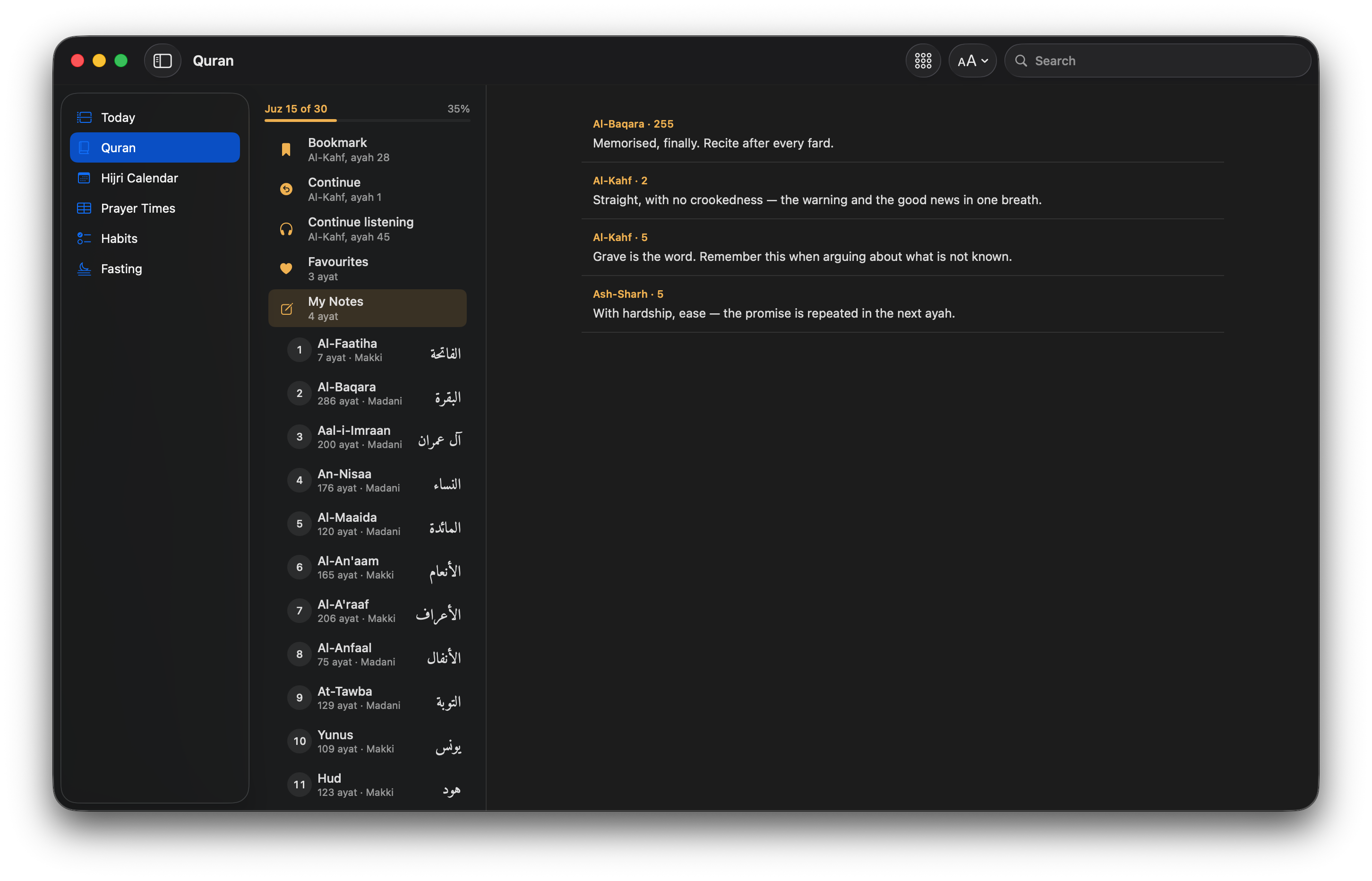
- My Notes — every note in mushaf order (2.7)
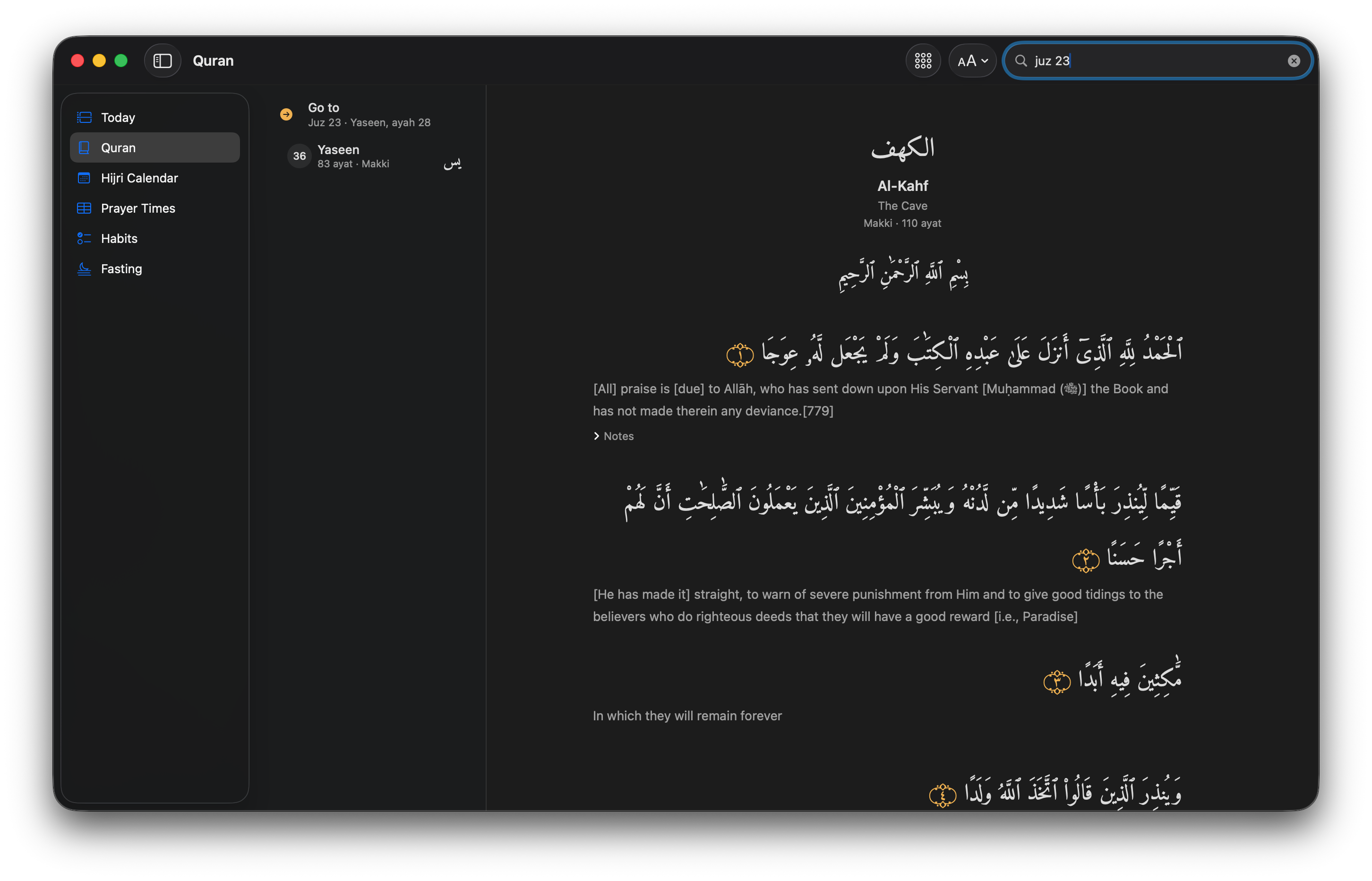
- Search — “juz 23” offers a Go to row for its first ayah (2.7)
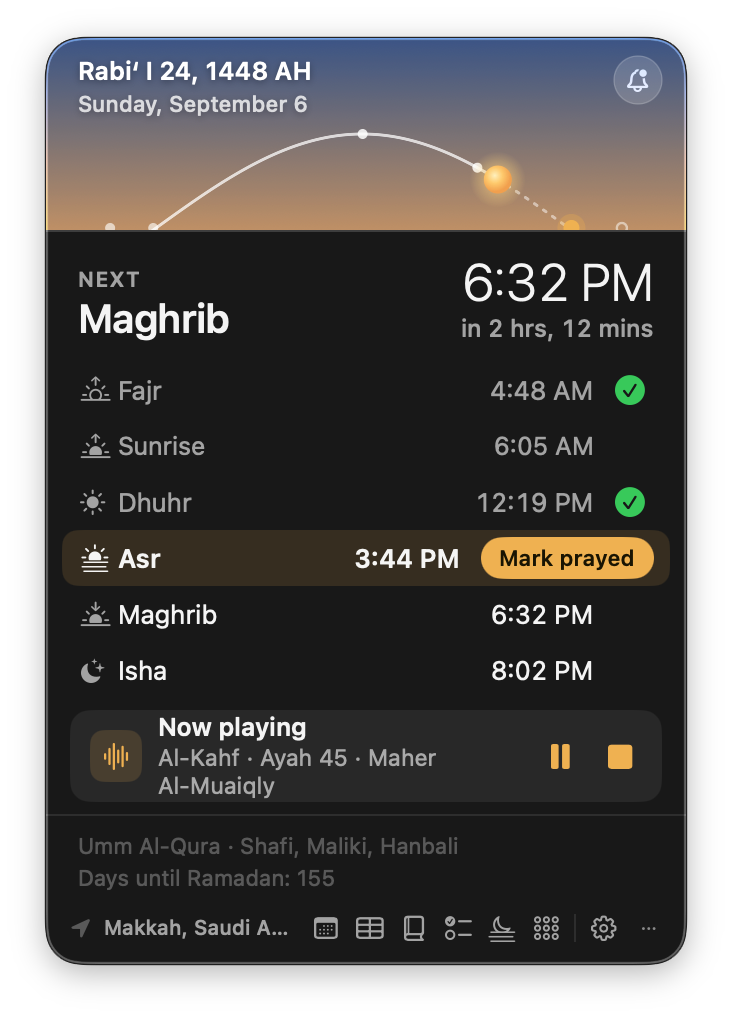
- The panel’s Now Playing card during a recitation
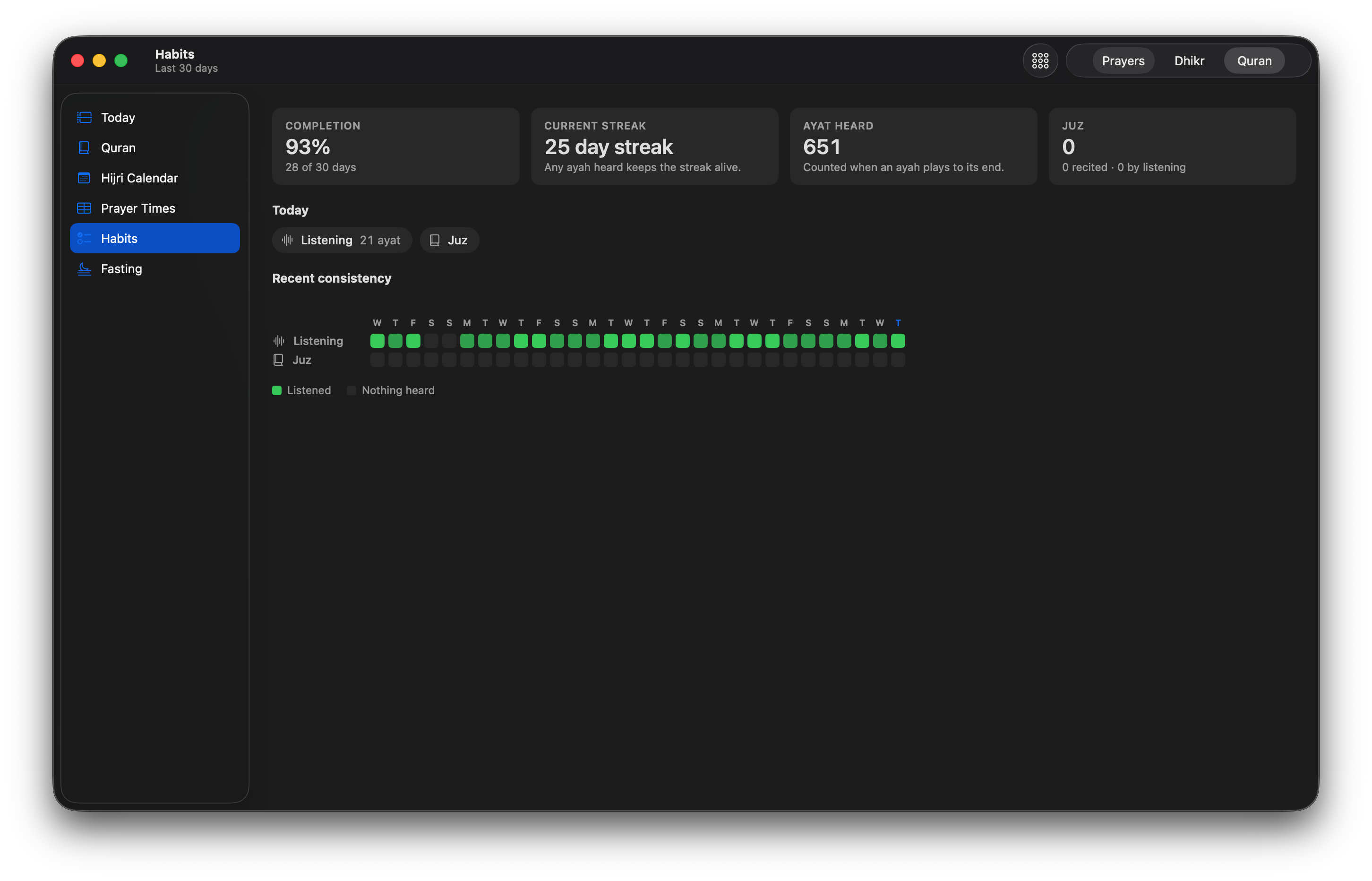
- The Habits window — the Quran listening mode, with the Juz row (2.9)
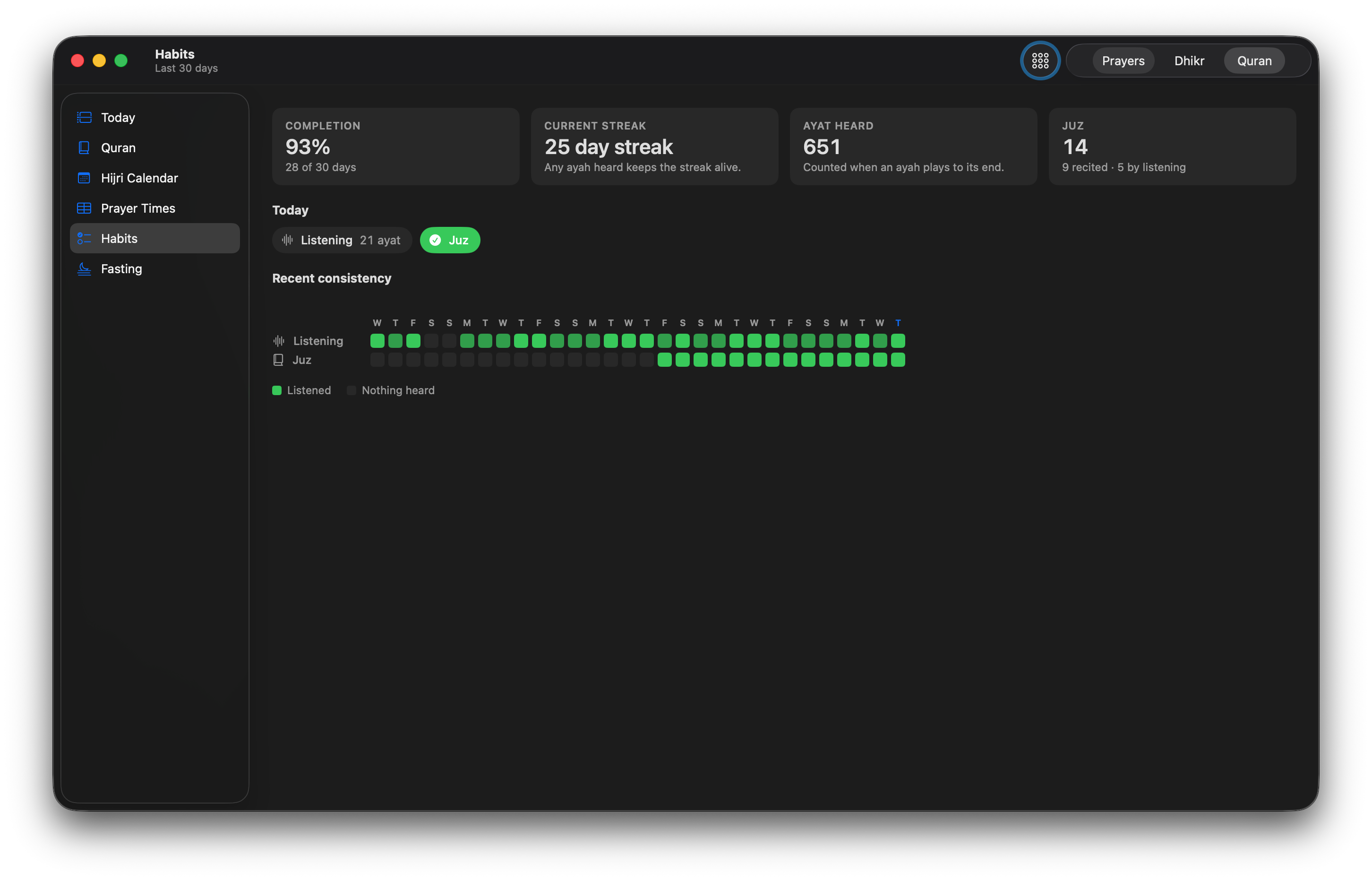
- The khatmah record — juz recited by hand and juz completed by listening, kept apart (2.7)
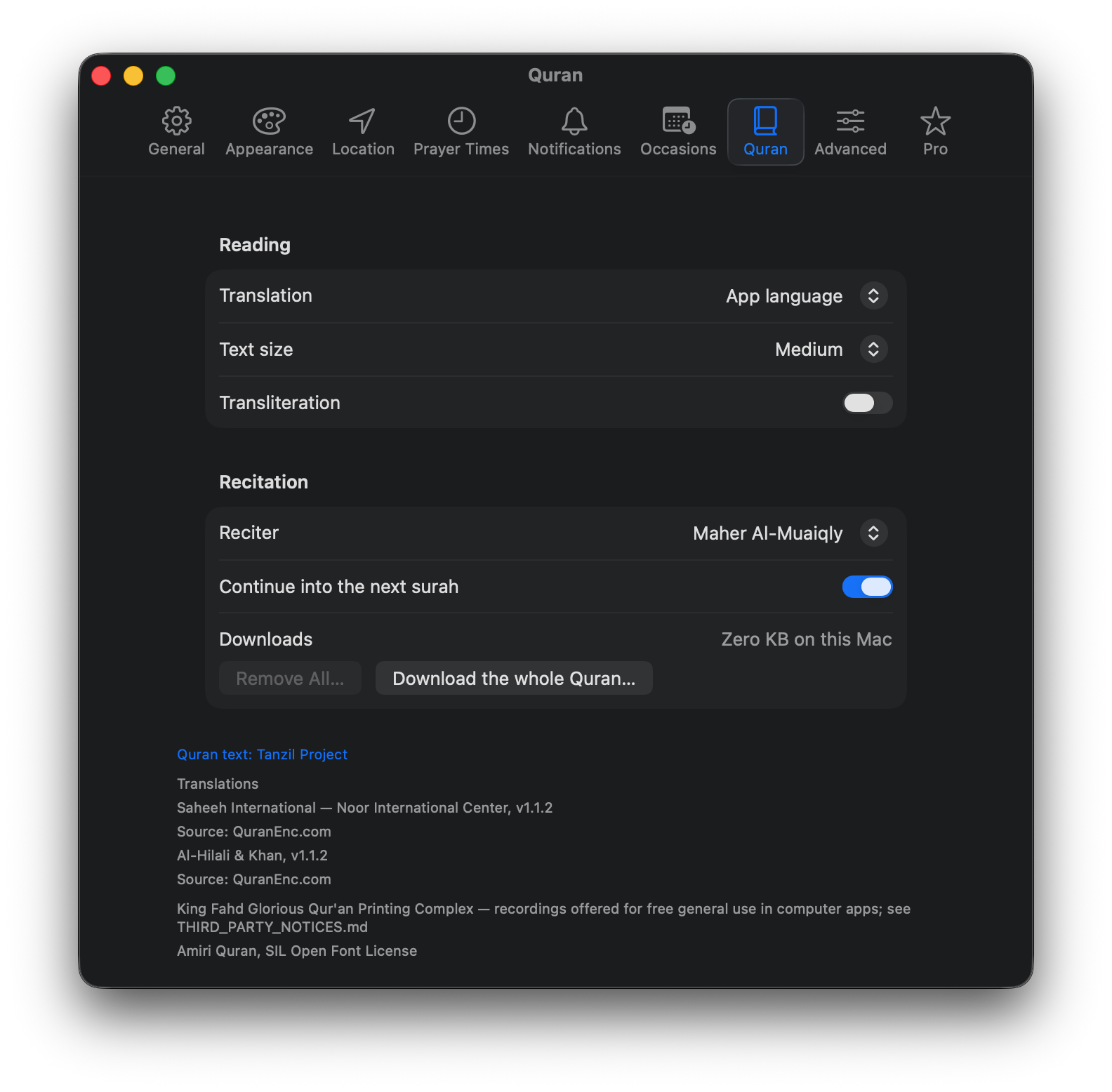
- Settings — the Quran pane: transliteration, the reciter menu, sources credited, and the whole-Quran download (2.9)
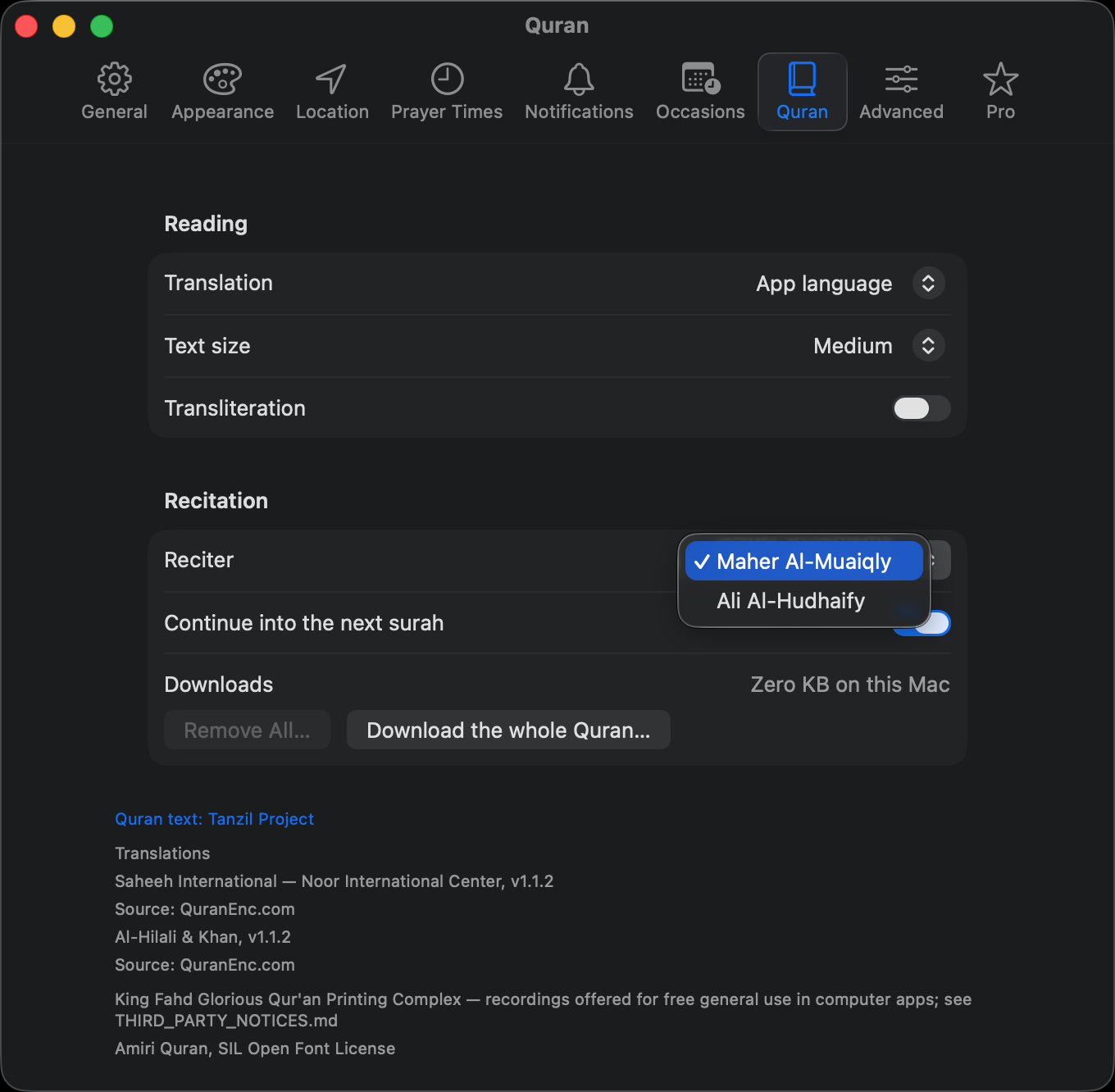
- The reciter menu open — Maher Al-Muaiqly and Ali Al-Hudhaify (2.7; flat capture, no transparency)
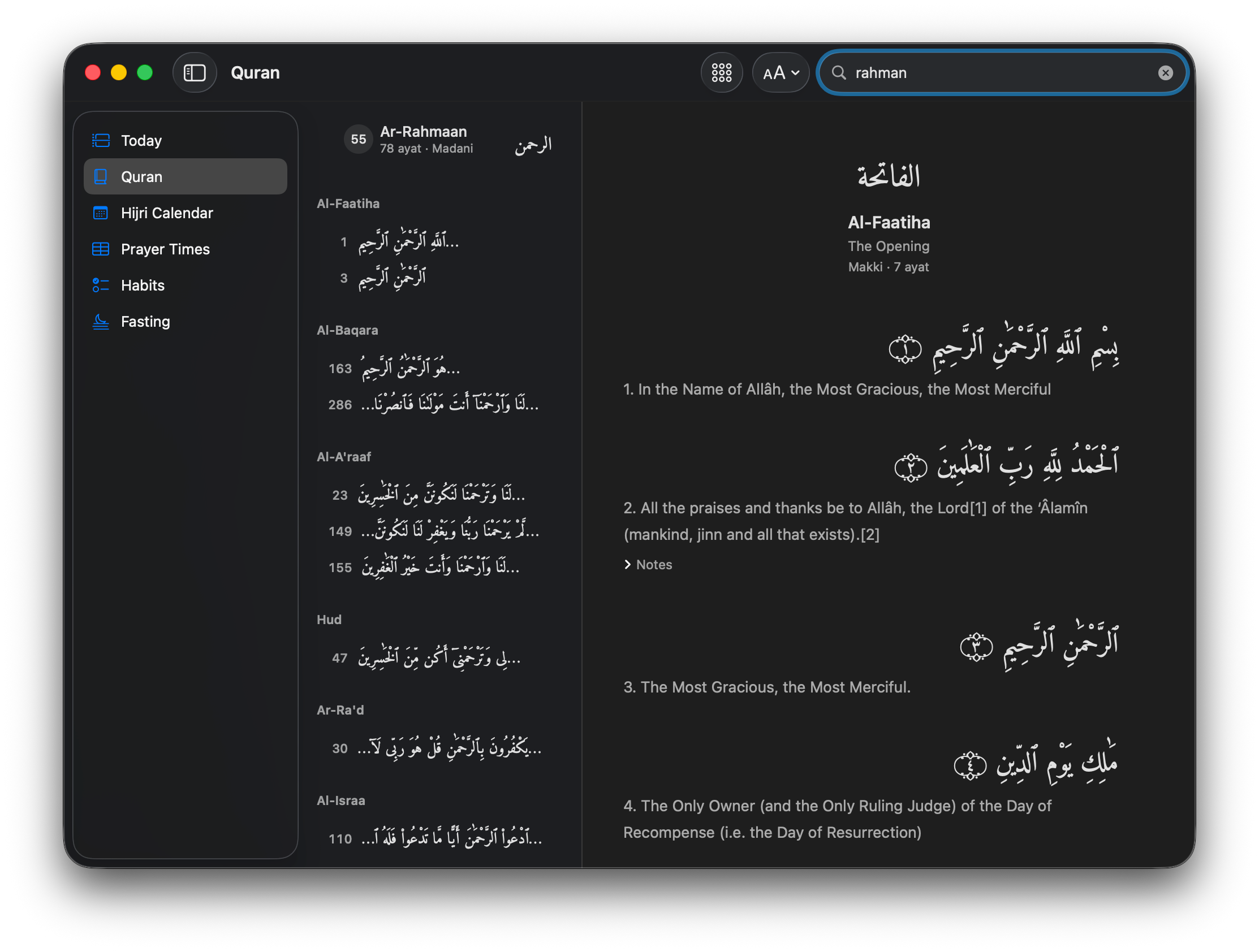
- Search — “rahman” finds the surah and every ayah that carries the word
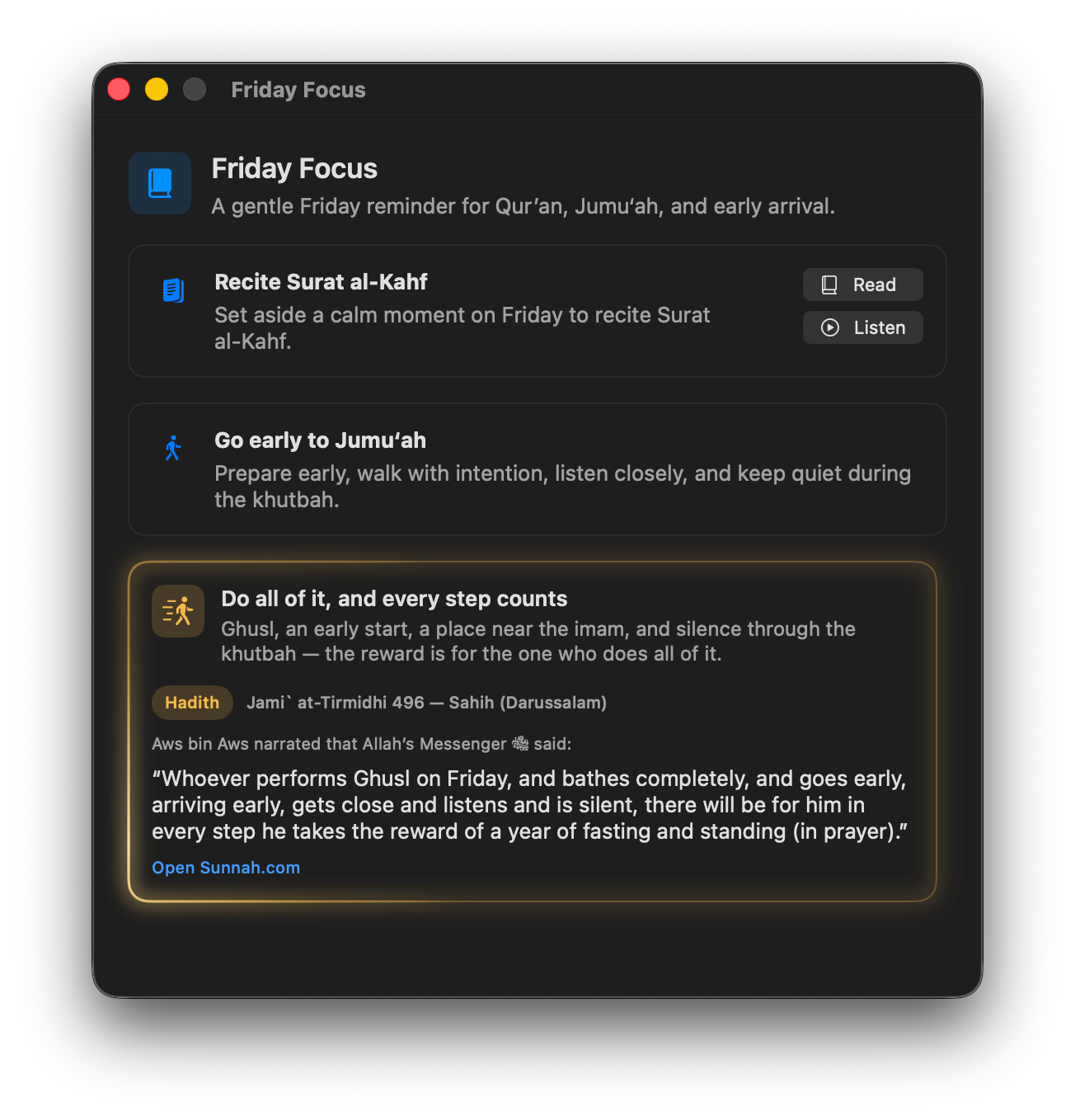
- The Friday Focus window — Read and Listen beside Surat al-Kahf, with the hadith and its grading
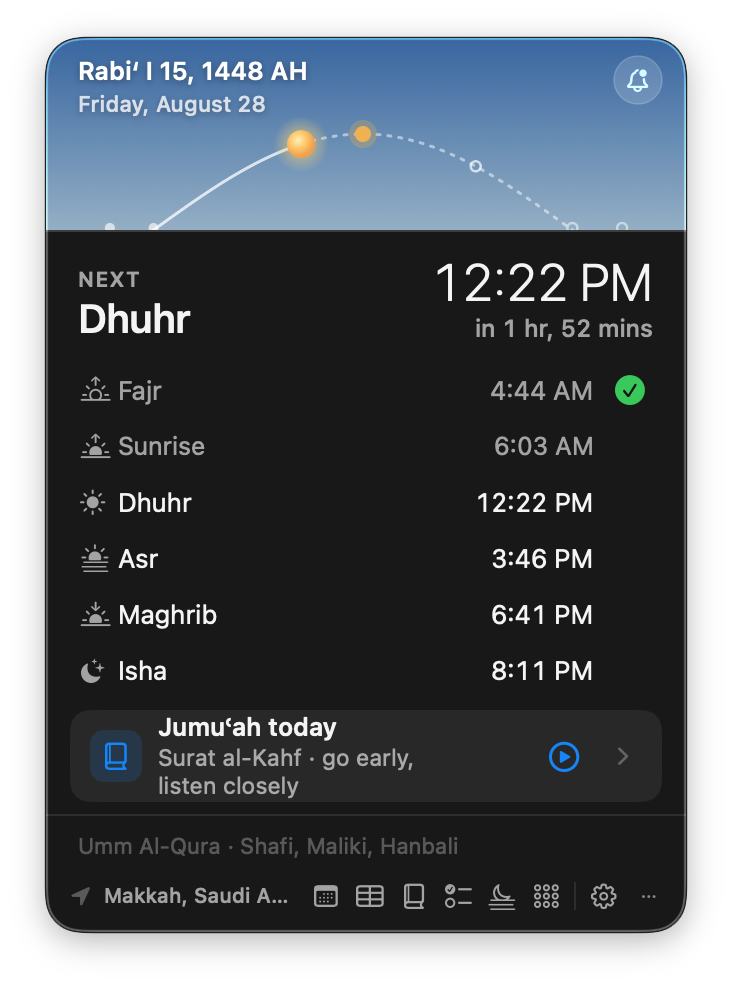
- The panel’s Jumu‘ah card — Surat al-Kahf with its play button, Fridays only
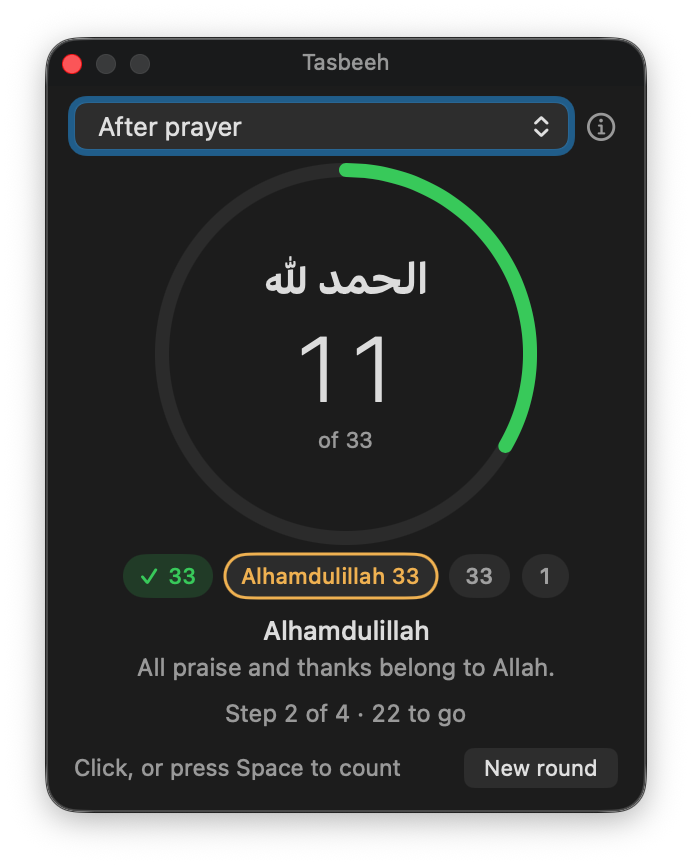
- The Tasbeeh panel — the After-prayer routine mid-round (2.5/2.6)
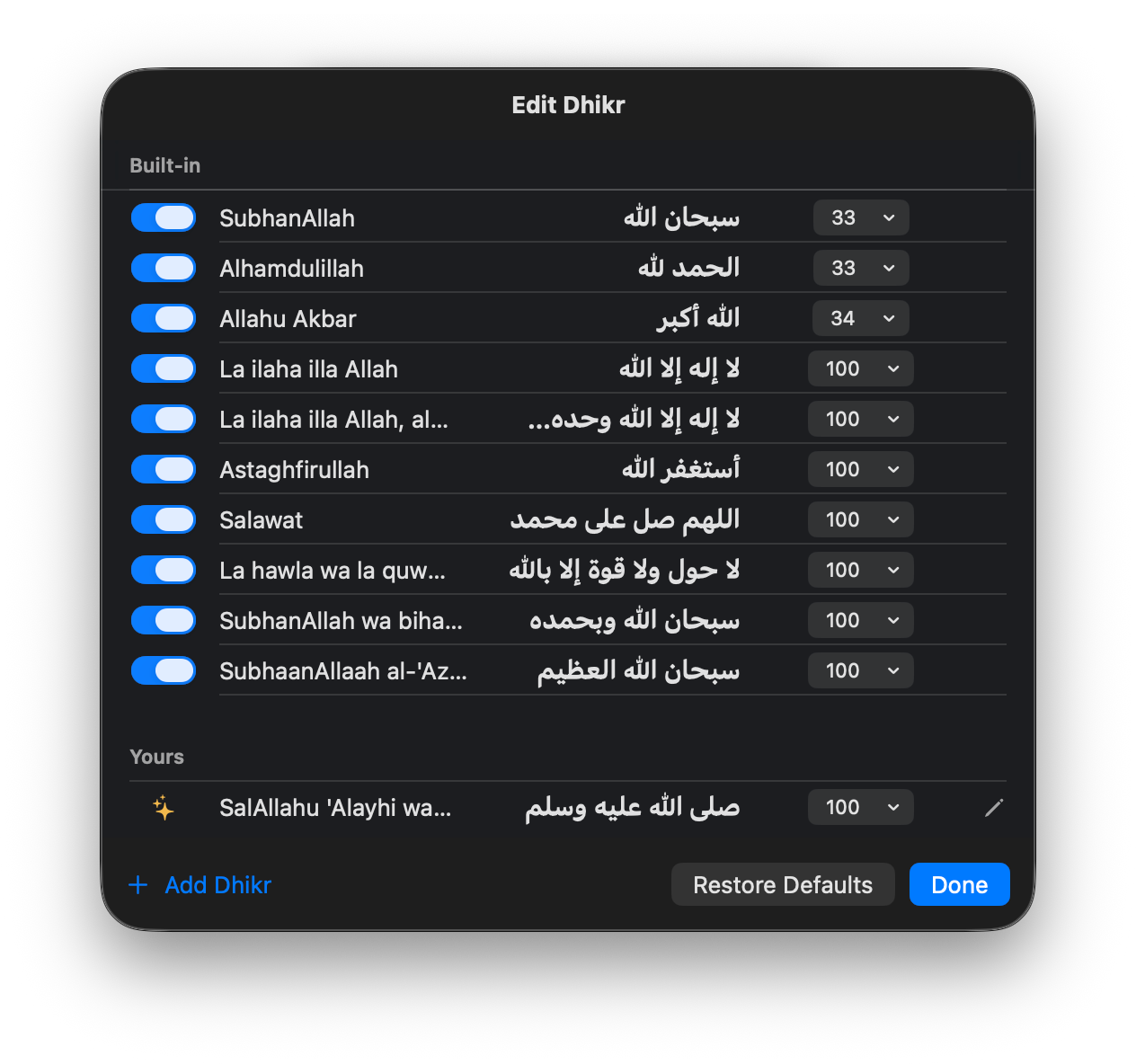
- Edit Dhikr — targets on the built-ins, a dhikr of your own under “Yours”
The app
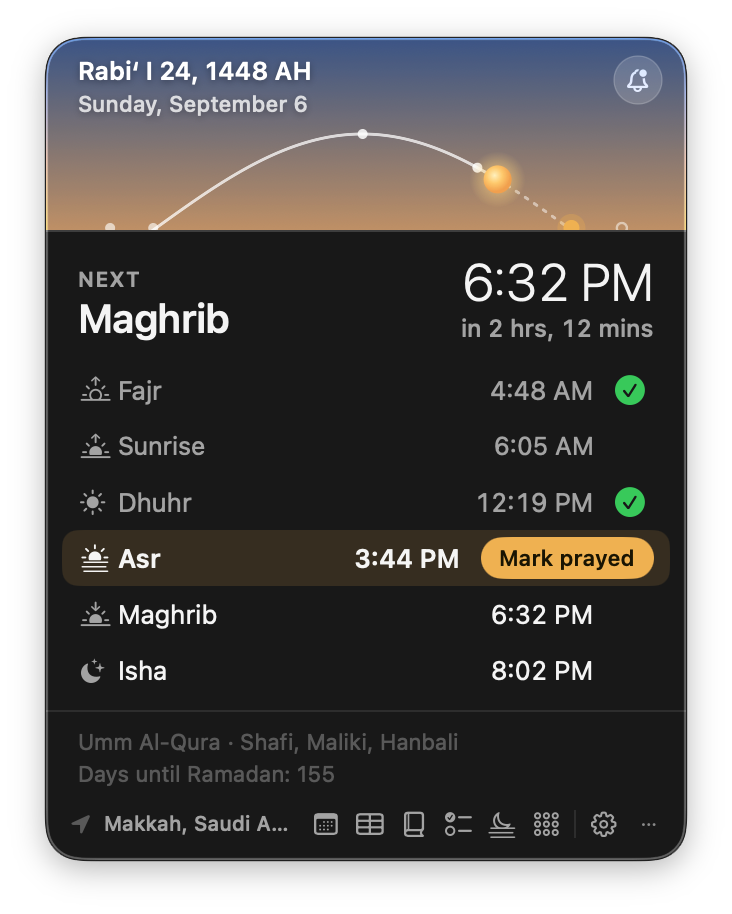
- The panel — Horizon face, golden hour
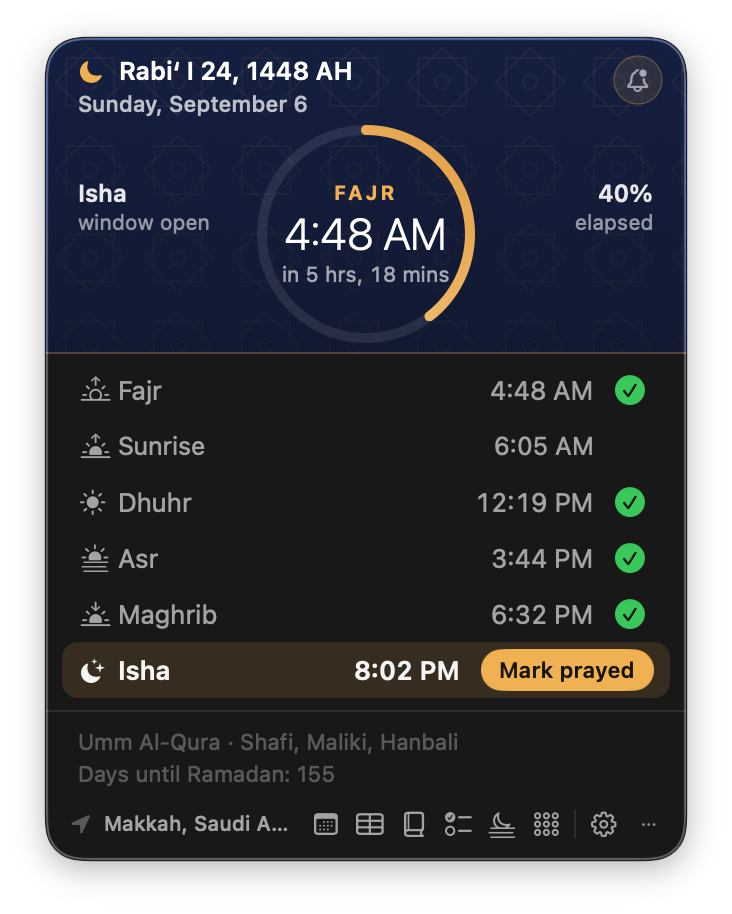
- The panel — Lantern night face
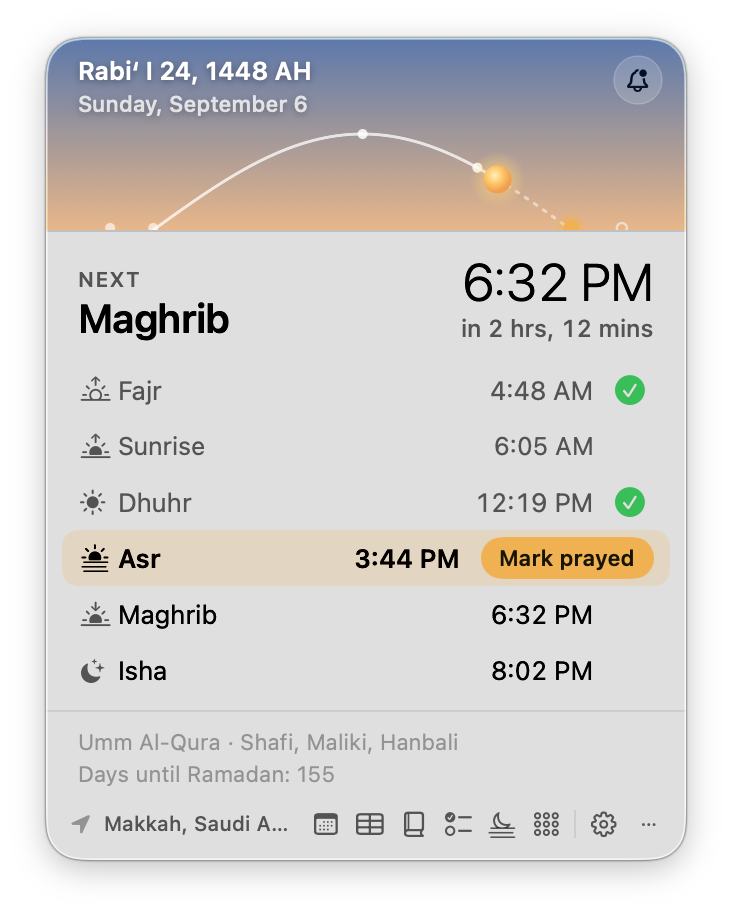
- The panel — light appearance
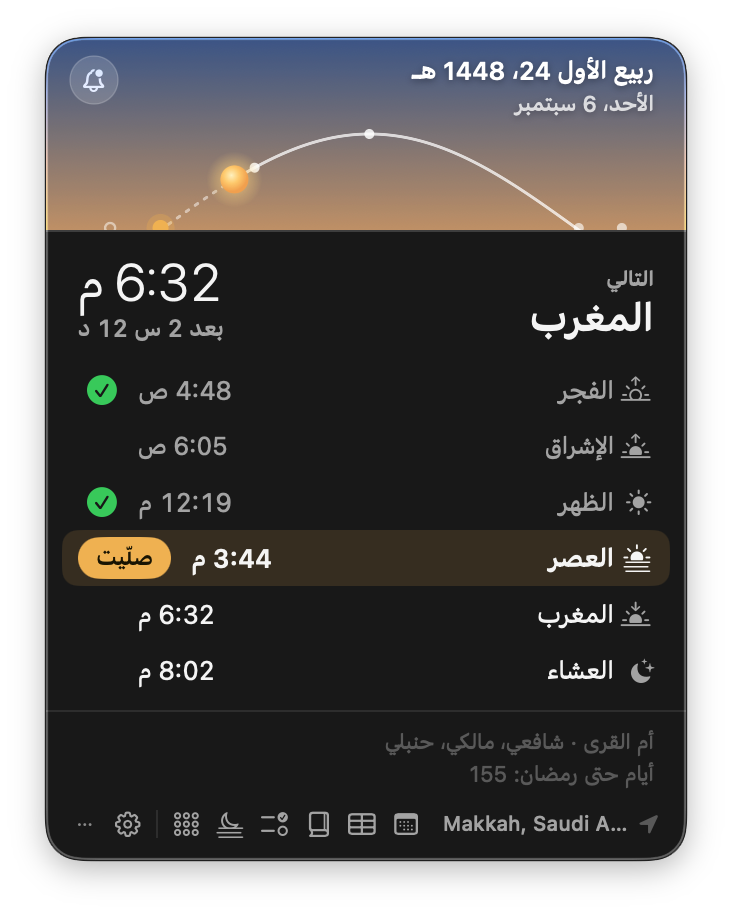
- The panel in Arabic — the arc runs right-to-left
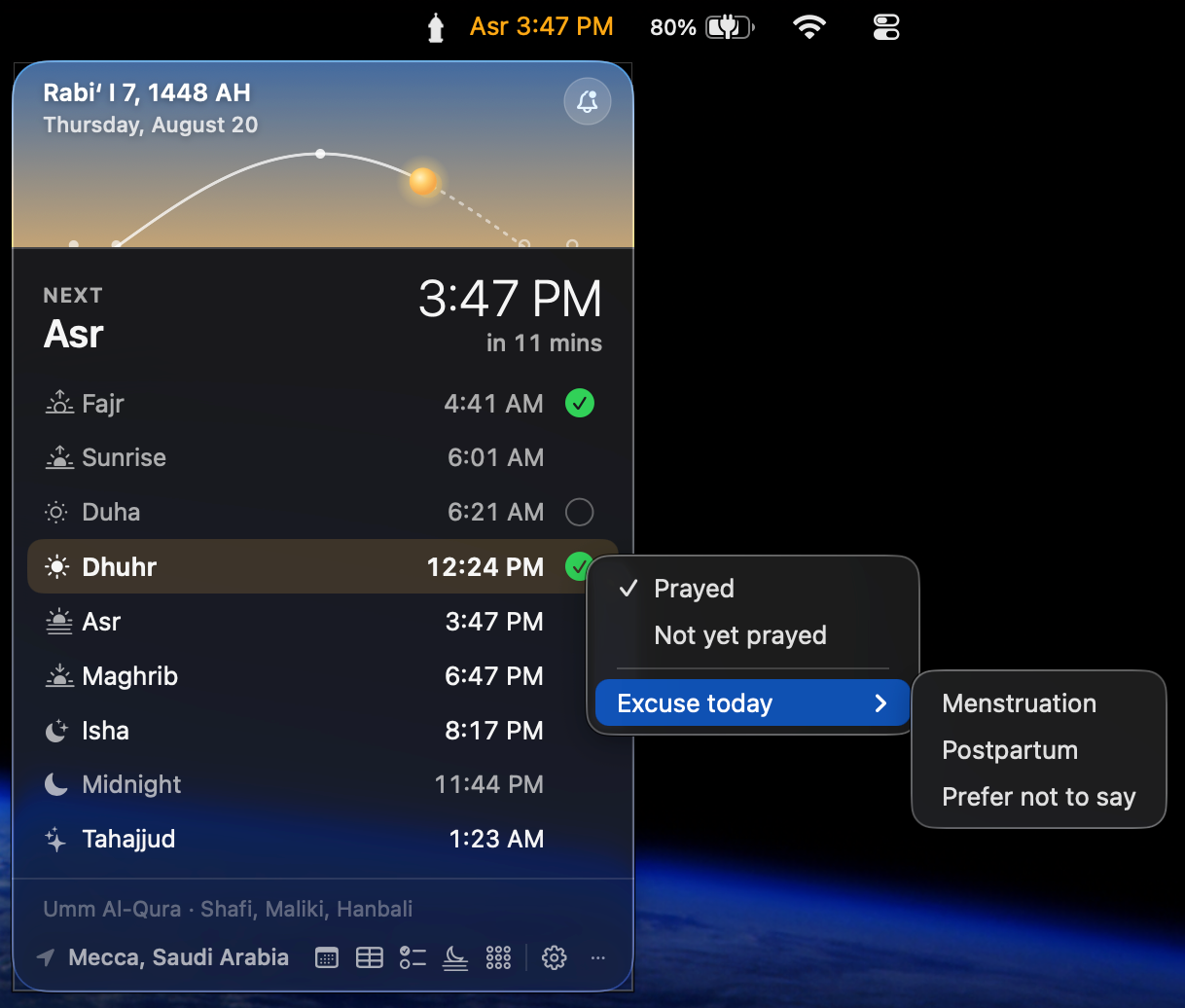
- Right-click on a prayer row — mark, unmark, or excuse
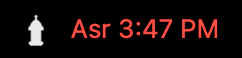
- Menu bar item · amber near the prayer · red in the last stretch
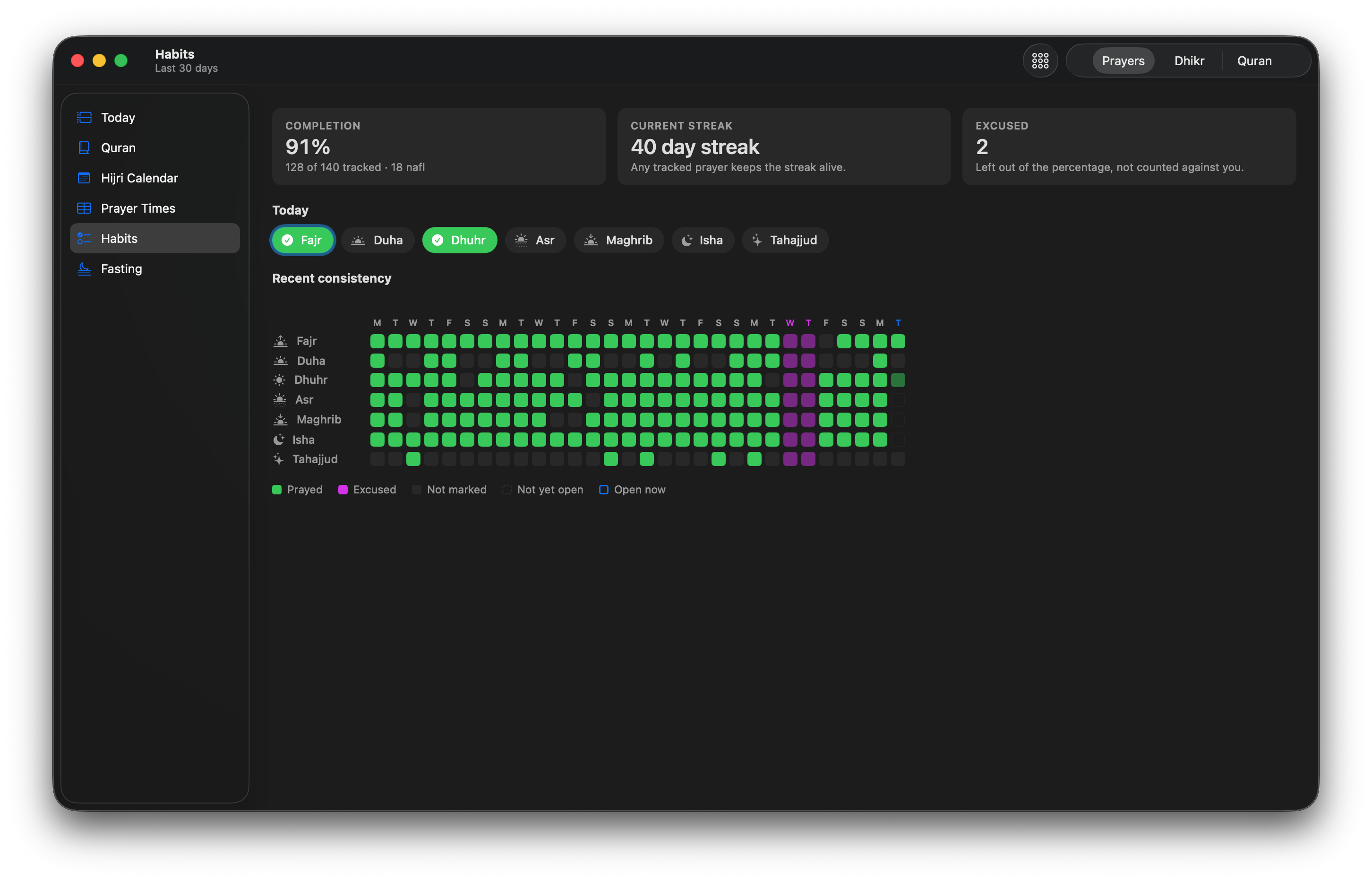
- The Iqamah window — Habits, with excused days in the grid
- Marking a day excused
- Excusing one prayer — right-click a square for Excuse Dhuhr or Excused from here… (2.8; flat capture, no transparency)
- The Iqamah window — Fasting, with the Ramadan ledger
- The Iqamah window — Hijri Calendar
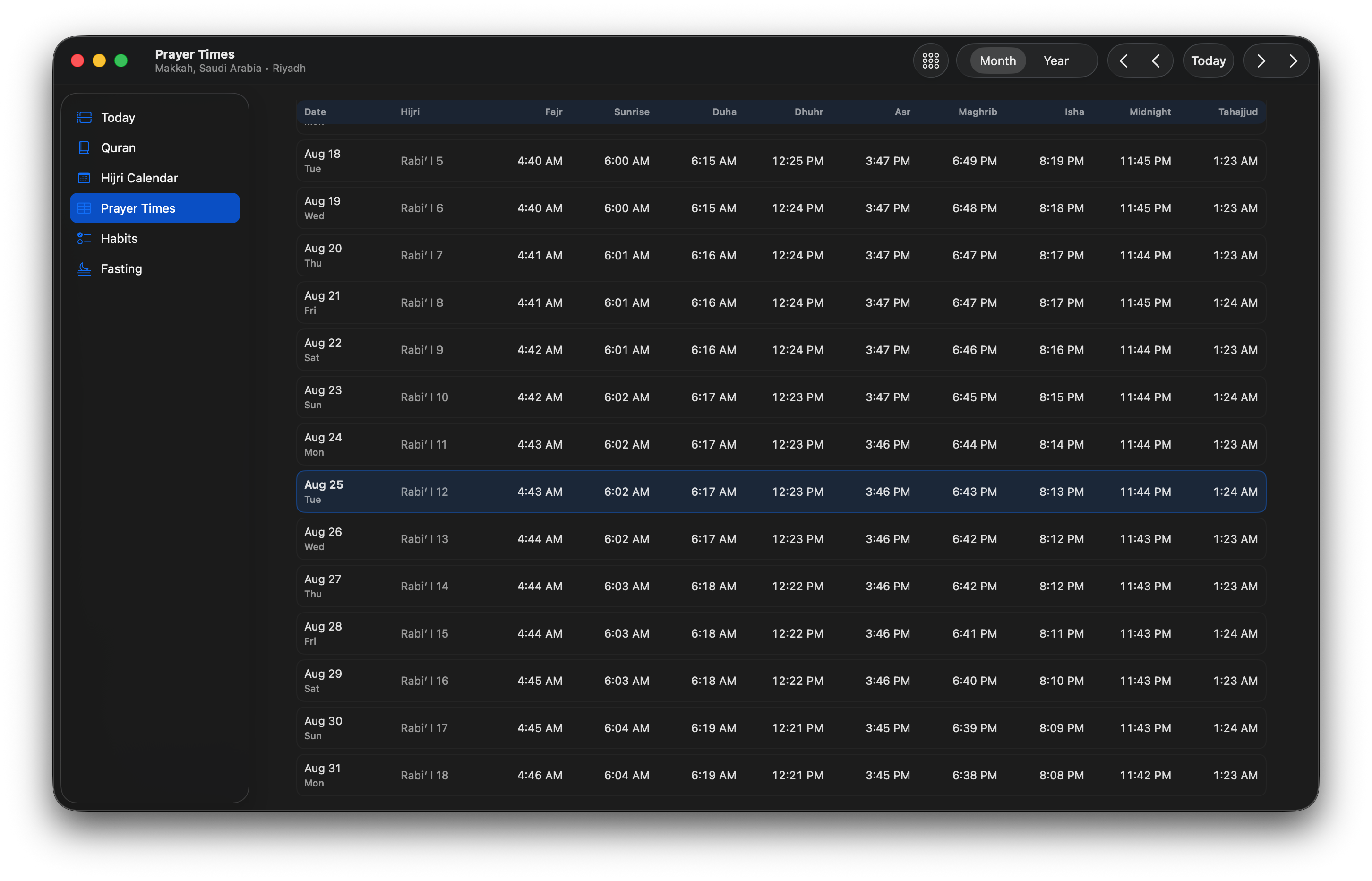
- The Iqamah window — Prayer Times, month view
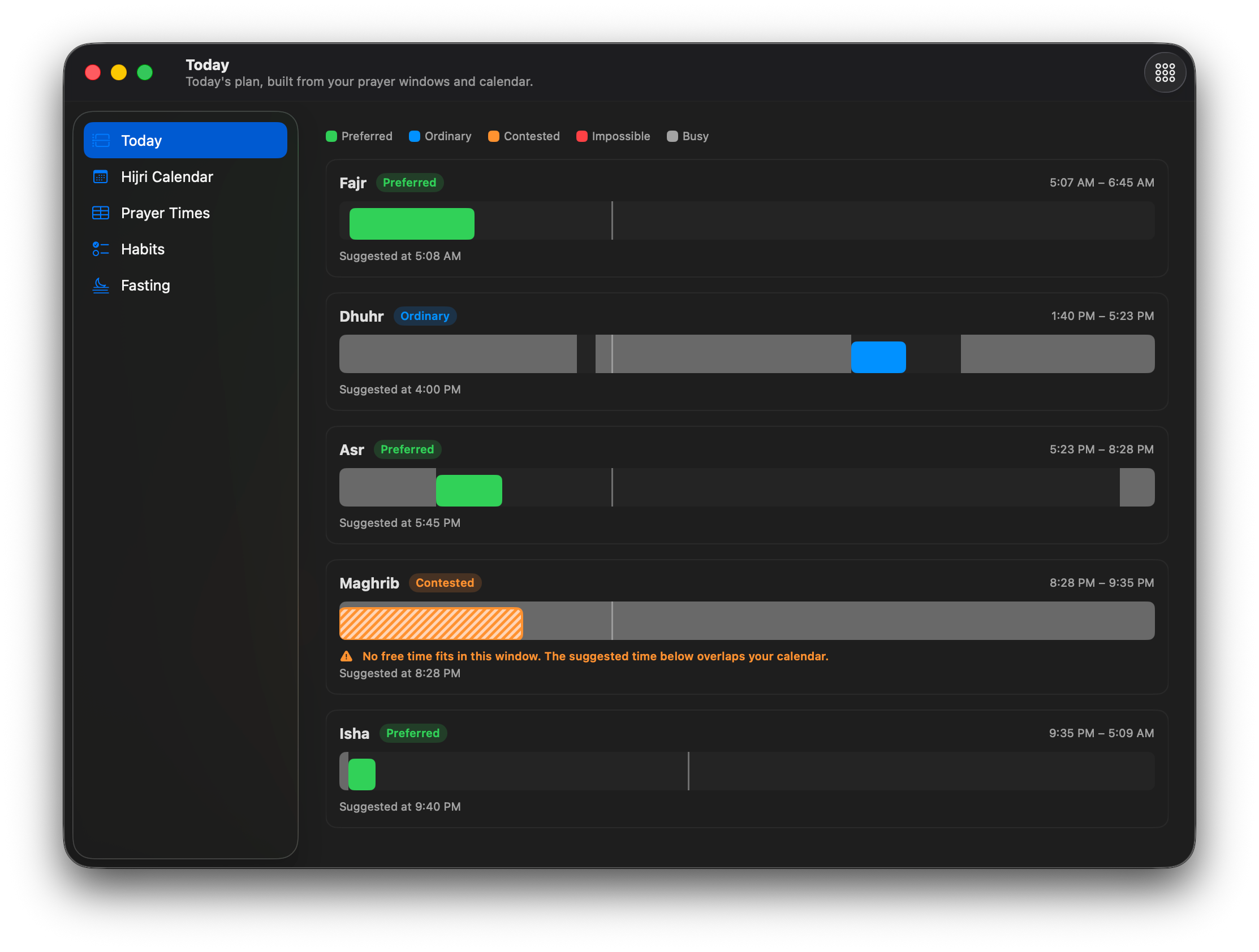
- The Iqamah window — Today, the Day Planner
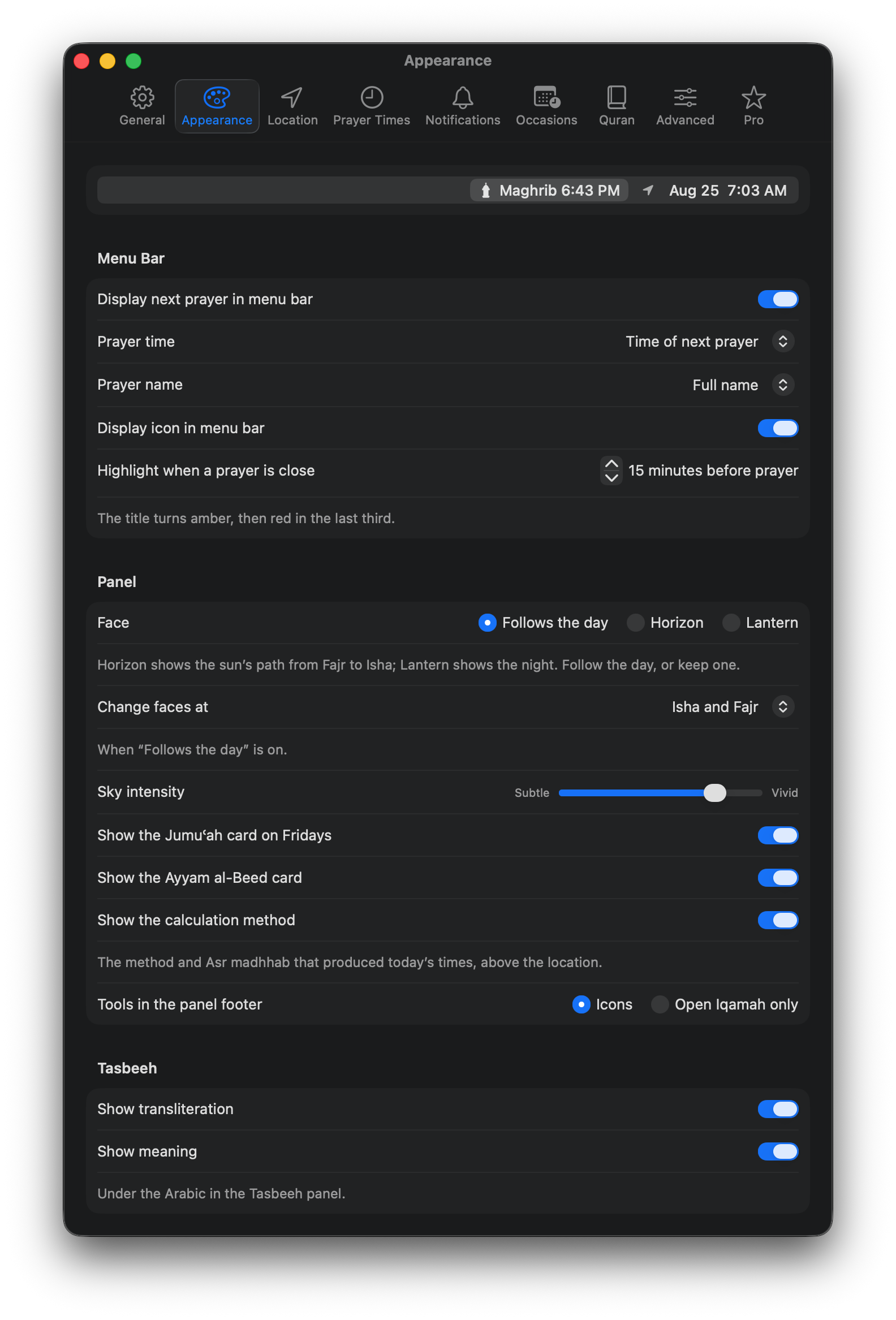
- Settings — the Appearance pane with its live preview
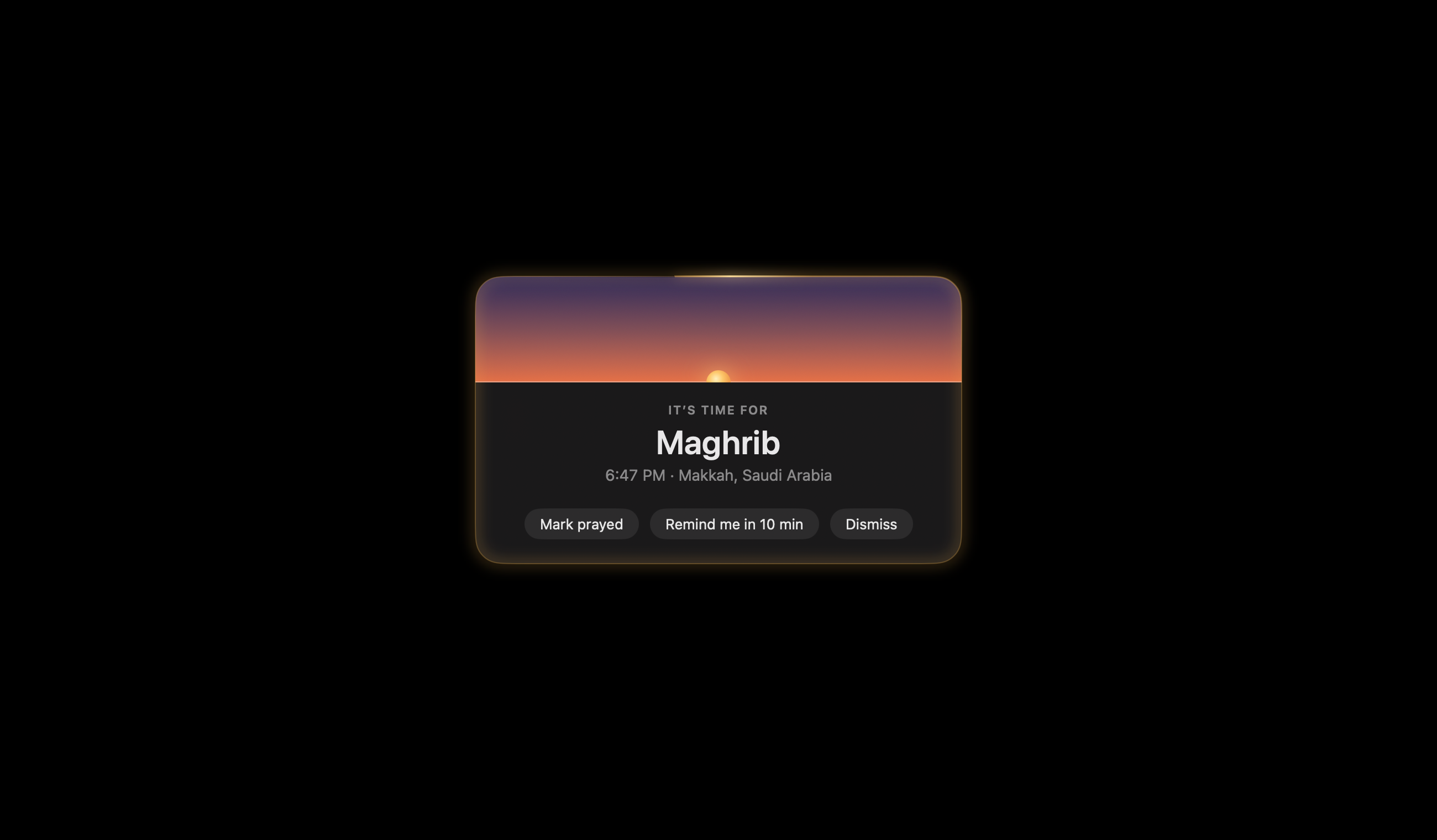
- The prayer-break overlay at Maghrib
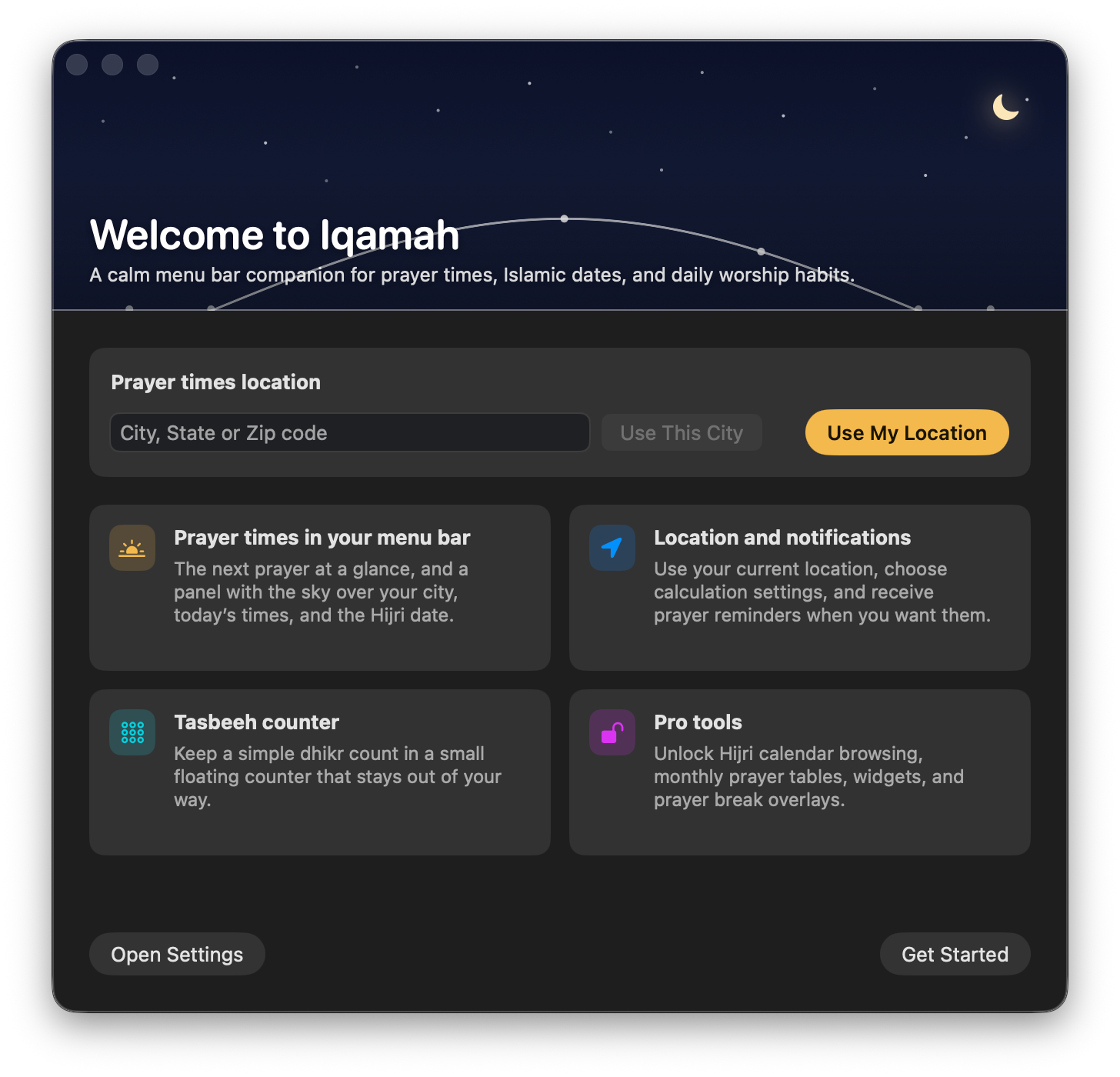
- The welcome window
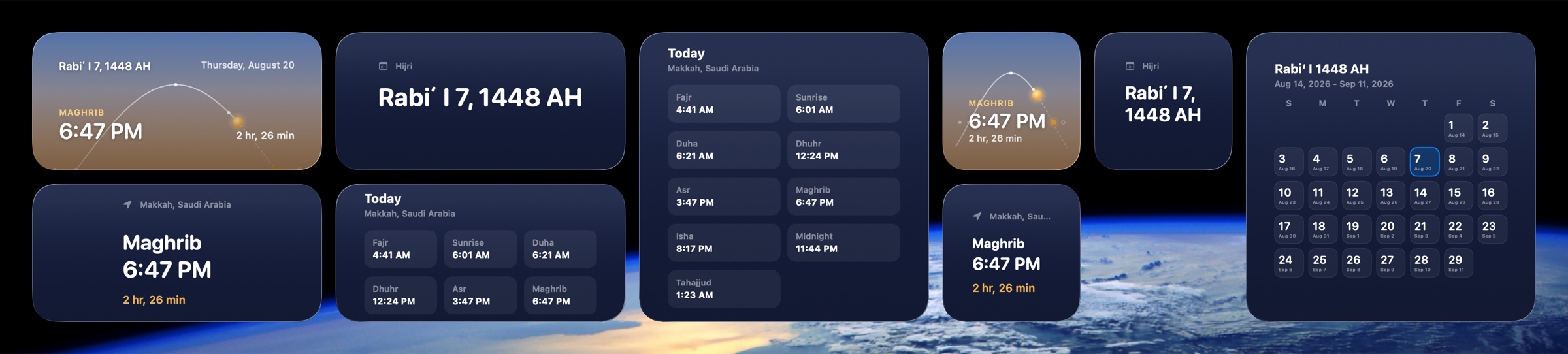
- The 2.1 widget family on the desktop (JPEG)
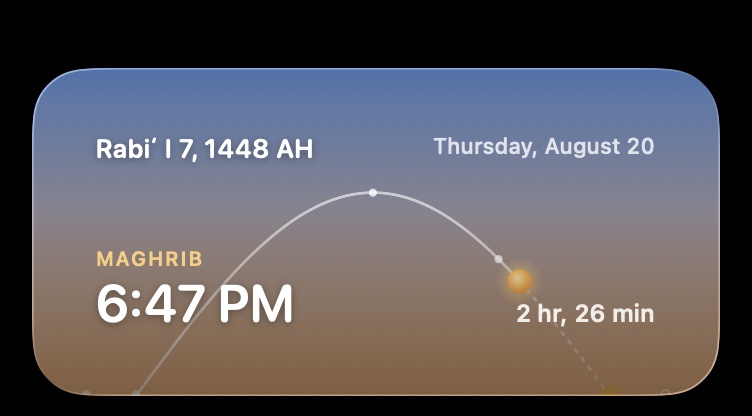
- The Sky widget by day — the sun on its arc (JPEG)
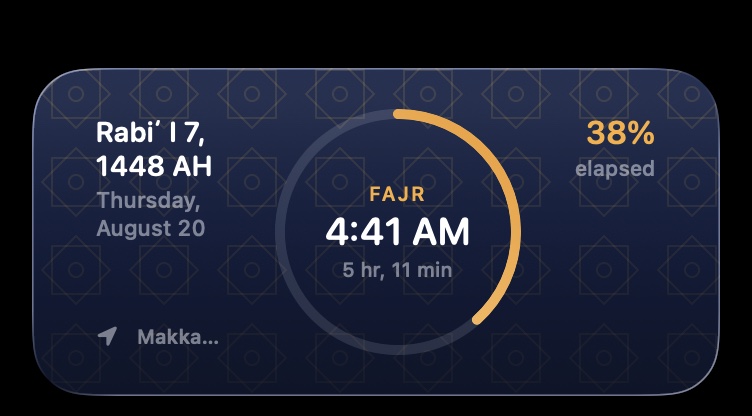
- The Sky widget after dark — the Lantern's ring (JPEG)
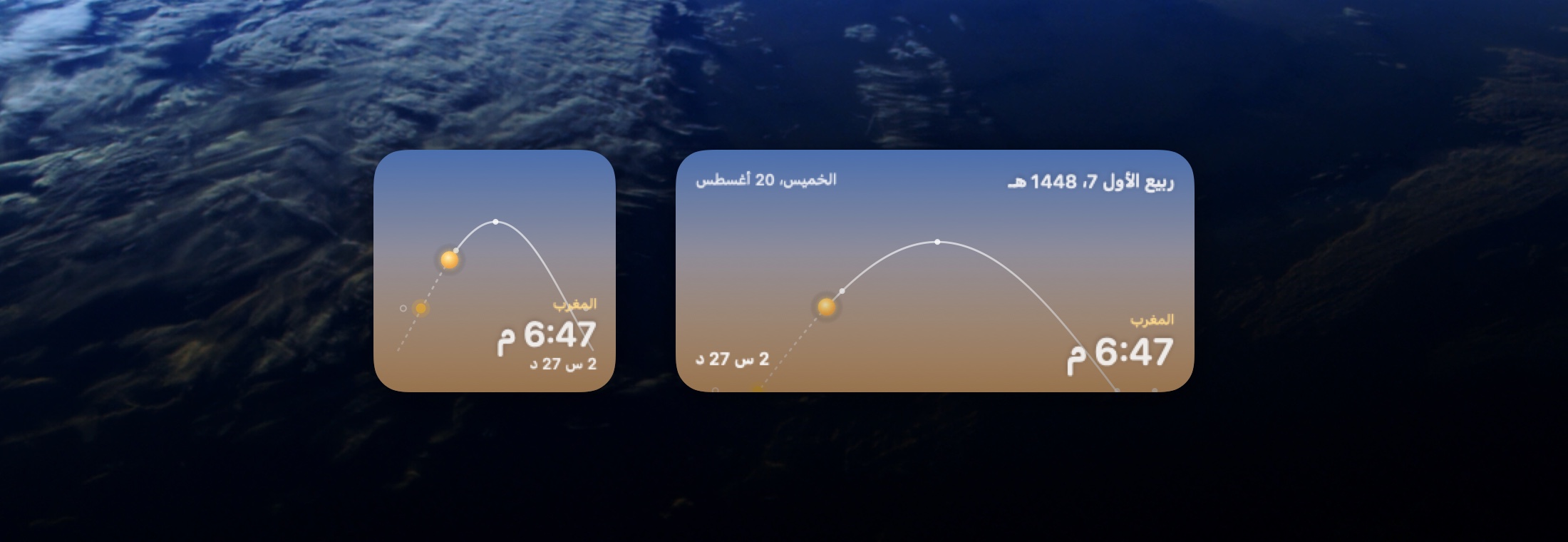
- The Sky widget in Arabic — the arc runs right-to-left (JPEG)
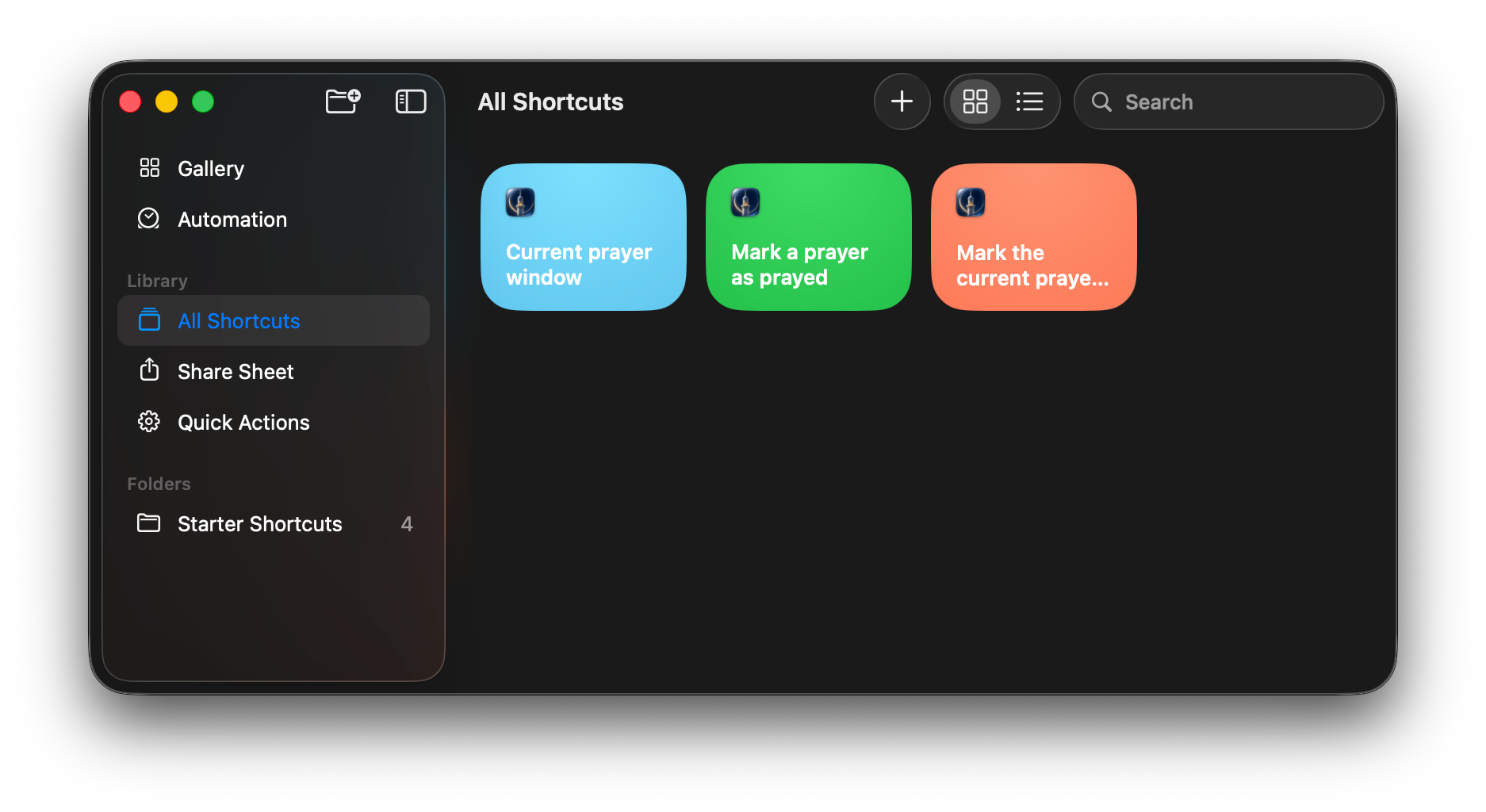
- Shortcuts actions, in the Shortcuts app


Icon
Things worth knowing
- No analytics in the app. None. Iqamah does not phone home, does not have an account system, and does not know who you are. Location, if you allow it, is used to calculate prayer times and is not sent anywhere. Calendar access, if you allow it, reads only when events start and end — never their titles, guests or notes — stays on the Mac, and writes nothing back. Settings sync, if you turn it on, writes to a folder you chose and reaches no server of ours; your location is excluded from it.
- The Quran’s sources are named in the app. The text comes from the Tanzil Project, the translations from QuranEnc.com, and the recitation is published by the King Fahd Glorious Qur’an Printing Complex — each credited with its version in Settings › Quran. The audio is served from Iqamah’s own storage, so no third-party service learns what anyone listens to. And it is all free: the reading, the listening, and the downloads.
- Listening is counted only when witnessed. The listening habit records an ayah only when its audio plays to the end — the one thing the app can actually attest to. There is deliberately no button to claim reading by hand.
- Excused days are designed around privacy and fiqh. A day you were not required to pray leaves the percentage instead of counting against you, and the streak carries across it. Since 2.8 the unit is the prayer: excuse one, or a range from Fajr one day to Dhuhr another, and only the prayers that were actually due are counted. The reason recorded never leaves the Mac, whatever sync settings say. Only what genuinely lifts the prayer is offered as an excuse; illness and travel live in the fasting record, where they genuinely do excuse a fast. Since 2.10 the way back out is on every square, Duha and Tahajjud included: The whole day is not excused clears it at once.
- The habit tracker became free in 2.0. It is where excused days are marked, and a purchase prompt is the wrong thing to meet somebody with at that moment.
- One purchase, three Macs, no subscription. Deactivate a Mac yourself from a link in your purchase email.
- If somebody cannot afford it, they can email and get a licence free, no questions asked. That is a standing offer, not a promotion.
- Since 2.10 the Today cards name a condition, not a clock. In the two long windows where prayer is not offered, it is voluntary prayer that is discouraged, and only once that window’s obligatory prayer has been prayed. Iqamah knows when the window opened and cannot know when somebody prayed, so the row reads After you pray Fajr rather than After Fajr. The twelve rak‘ah beside them — two before Fajr, four before Dhuhr and two after, two after Maghrib, two after Isha, and none at all for Asr — follow the same principle: the ones that come after a prayer sit past the end of its own slot in the day planner rather than on its adhan, so each row is a time it could actually be prayed.
- Prayer times are calculated, not authoritative. The app says so, and the calculation method is configurable, because communities differ and an app should not pretend otherwise.
Why it exists
Every prayer times app available on macOS was either a website in a wrapper, a widget that quietly stopped updating, or something that wanted an account to tell you when to pray. Iqamah was written because a Mac deserves a real Mac app for this, and because the reward for helping somebody pray on time is worth more than the licence fee.